
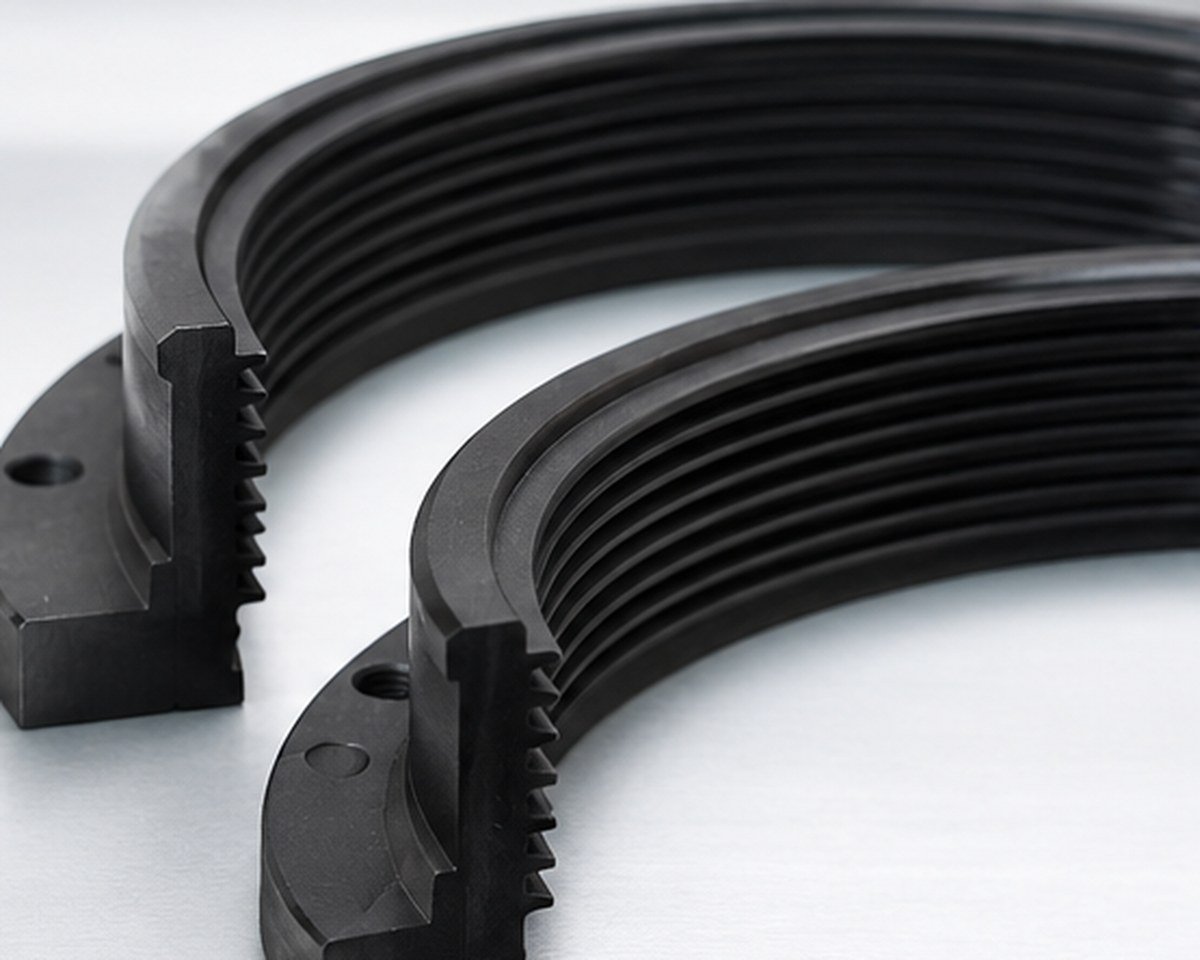
Description
The LB-1610 Labyrinth Seal is a precision non-contact sealing device designed to control leakage between high-pressure and low-pressure zones in rotating equipment. Its multi-tooth labyrinth geometry creates a tortuous flow path that dissipates pressure energy through staged restrictions, cavities, and controlled vortices, reducing gas, steam, oil mist, or process leakage without rubbing contact on the shaft. This operating principle is widely used in compressors and turbines, where labyrinth seals separate pressure zones and support machine efficiency.
The LB-1610 is suitable for turbomachinery and industrial rotating equipment operating in dry gas, steam, air, oil mist, and general process environments. Depending on duty conditions, the seal may be supplied in metallic, thermoplastic, split, straight-tooth, stepped-tooth, or slanted-tooth configurations. Thermoplastic labyrinth designs can permit tighter running clearances than metallic seals, helping reduce leakage and improve efficiency in multi-stage centrifugal compressors.
Technical Key Features
- Multi-tooth labyrinth geometry reduces leakage through staged pressure breakdown.
- Split or solid configuration for new assemblies, overhaul work, and retrofit installation.
- Non-contact, frictionless operation minimizes shaft wear, heat generation, and scoring.
- Metallic or thermoplastic construction available for temperature, chemical, and rub-tolerance optimization.
- Straight, stepped, or slanted tooth profiles available according to leakage, clearance, and rotor-dynamic requirements.
- Suitable for high-speed rotating equipment, including compressors, turbines, turbo-expanders, blowers, and bearing housings.
- Custom-engineered clearances based on shaft diameter, bearing clearance, thermal growth, speed, and pressure differential.
Service Overview
| Parameter | Value |
|---|---|
| Equipment | Centrifugal compressors, steam turbines, gas turbines, turbo-expanders, blowers, pumps, gearboxes, bearing chambers |
| Fluid | Air, gas, steam, oil mist, inert gases, light process vapours, clean or moderately contaminated service media |
| Service Nature | Non-contact leakage control, pressure-zone separation, bearing contamination reduction, and lubricant migration control |
| Operating Mode | Continuous rotation, high-speed service, start-stop duty, overhaul/retrofit installation |
Specifications
| Item | Min | Max | Typical/Notes |
|---|---|---|---|
| Size | 19.0 mm (0.748”) | 500.0 mm (19.685”) | Custom sizes made against the shaft, bore, and housing drawing |
| Pressure | Atmospheric | Application-specific | Engineered to pressure differential, tooth count, clearance, and media density |
| Temperature | -40°C (-40°F) | +200°C (+392°F) | Higher-temperature designs on request with suitable metallic or engineered-polymer materials |
| Speed | — | 35 m/s (6,890 fpm) | Surface speed at shaft OD; higher-speed turbomachinery duties require rotor-dynamic and clearance review |
Materials
| Component | Standard Material | Optional Material | Comment |
|---|---|---|---|
| Seal Body / Stator | Bronze, SS 304, SS 316 | Aluminium bronze, carbon steel, alloy steel, Duplex SS | Selected by temperature, corrosion, and housing design |
| Labyrinth Teeth | Integral metallic teeth | PEEK, PAI (Torlon®), Fluorosint® PTFE | Thermoplastics may support tighter clearances and anti-galling behaviour |
| Retaining / Split Hardware | SS 304 / SS 316 | Alloy steel, Inconel, Hastelloy | Based on mechanical loading and environment |
| Secondary Sealing / Anti-Rotation Parts | NBR / FKM / PTFE where required | EPDM, FEP-encapsulated FKM, graphite packing | Used only where the design requires static sealing |
Applications
- Centrifugal compressors: impeller eye seals, interstage seals, balance piston seals, and shaft end seals.
- Utility steam turbines, land-based gas turbines, and turbo-expanders.
- Blowers, exhaust fans, and high-speed air/gas handling equipment.
- Bearing housings for pumps, motors, conveyors, and general rotating equipment.
- Industrial gearboxes and gear reducers requiring oil mist or contamination control.
- Retrofit upgrades where reduced leakage, non-contact operation, and improved reliability are required.
- Chemical, petrochemical, power generation, steel, cement, pulp & paper, food & beverage, and pharmaceutical plants.
Operating Limits
| Parameter | Value |
|---|---|
| Pressure | Application-specific; engineered to pressure differential and leakage target |
| Temperature | -40°C to +200°C (-40°F to +392°F), material dependent |
| Speed | Up to 35 m/s (6,890 fpm) for standard configuration; higher speeds on request |
| Size Range | 19.0 mm to 500.0 mm (0.748” to 19.685”); custom sizes on request |
Final selection is verified against the shaft drawing, bore size, tooth geometry, radial clearance, operating temperature, pressure differential, medium, and rotor-dynamic behaviour.
Related Products
- BI1710-NF Non-Flooded Bearing Isolator: non-contact bearing protection for pumps, motors, and gearboxes.
- SR-1605 Carbon Segmented Ring: segmented carbon gland seal for steam turbines and compressors.