
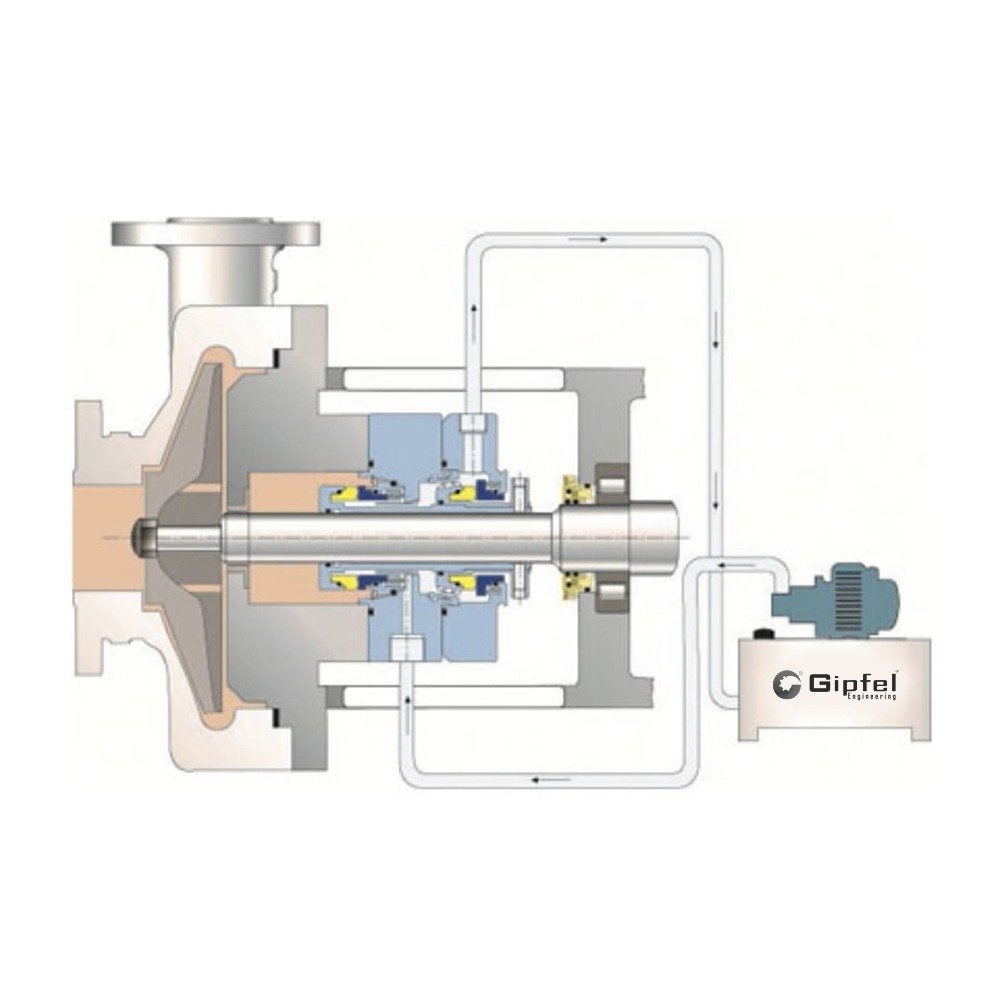
Description;
API Plan 54 is a high-performance, externally pressurized barrier-fluid circulation system for Arrangement 3 dual mechanical seals, designed for demanding process services where reliable seal protection, controlled leakage management, and effective heat removal are essential. It supplies a clean, cool, compatible, and lubricating barrier liquid to the seal faces at a pressure above the seal-chamber pressure, with barrier pressure and circulation provided by an external pump or pressure source for stable operation independent of process pump condition.
This system is well-suited to severe-duty applications where process leakage to atmosphere must be avoided, the process fluid is unsuitable for seal-face lubrication, or higher barrier-flow rates are required for thermal control.
Typical applications include light hydrocarbons, high-vapour-pressure fluids, hazardous or toxic media, heat-transfer fluids, dirty or abrasive services, polymerizing fluids, vacuum equipment, mixers, agitators, and other critical rotating equipment.
API Plan 54 can be engineered for single- or multi-seal duty, subject to proper sizing, hydraulic isolation, and system design. It may be configured with site-specific instrumentation and accessories such as pressure and temperature indicators, flow monitoring, filters, heat exchangers, valves, and accumulators to support safety, monitoring, and maintenance requirements.
With its flexible system architecture and dependable external pressurization, API Plan 54 delivers consistent barrier-fluid circulation, enhanced thermal management, and robust support for pressurized dual mechanical seals. It is a proven solution for high-temperature, high-pressure, abrasive, polymerizing, and high-vapour-pressure applications where long-term operational reliability is critical.
Key features and advantages;
· System interior can be dismantled for cleaning and inspection, supporting easier maintenance and reliable long-term performance.
· Supports hazardous, toxic, and demanding operating conditions, provided the barrier fluid is clean, compatible, cool, and lubricating.
· In multi-seal arrangements, failure of one seal installation can affect others unless adequate isolation and protective measures are provided.
· Can be configured to supply multiple seal installations when properly engineered, sized, and isolated, helping reduce overall system cost and footprint.
· May be supplied as a stand-alone skid or header-fed system, allowing integration with a plant barrier-fluid source or installation as a self-contained package.
· Suitable for high thermal-duty applications, making it appropriate where standard pressurized seal support arrangements require additional cooling capacity.
· Barrier-fluid pressure is typically maintained 1–2 bar(g) above seal-chamber pressure, ensuring stable operation and controlled leakage toward the process side.
· Provides external barrier-fluid circulation and cooling, delivering positive flow for lubrication and heat removal at both seal faces even when the process pump is not running.
· If pressure is lost, process fluid may enter the system, so proper safeguards, isolation provisions, and operating procedures are essential, especially in multi-seal applications.
· Instrumentation can be customized with pressure and temperature gauges, flowmeters, filters, accumulators, valves, and heat exchangers for improved monitoring and control.
· Designed for pressurized dual-seal service, maintaining barrier-fluid pressure above seal-chamber pressure to isolate the process fluid and protect the environment from fugitive emissions.
Service Overview;
Parameter Value
Equipment Pressurized dual mechanical seals, process pumps, mixers, agitators, vacuum equipment, and high-temperature rotating equipment
Fluid Clean compatible barrier fluid; process services may include light hydrocarbons, hazardous/toxic fluids, heat-transfer fluids, dirty fluids, abrasive fluids, and polymerizing fluids
Service Nature High pressure, high temperature, hazardous, flashing, poor-lubricating, abrasive, polymerizing, or emission-sensitive service
Operating Mode Continuous external circulation with controlled barrier pressure and flow
Seal Arrangement API Arrangement 3 / pressurized dual seal
Barrier Pressure
Philosophy Barrier pressure maintained above seal chamber pressure, typically by at least 1.0–2.0 bar (14.5–29 psi) or per project specification
Specifications;
Item Min Max Typical/Notes
Size On Request 400 L (105.7 gal) Standard reservoir capacity shown as 400 L (105.7 gal); 150 L (39.6 gal), and custom tank sizes may be engineered
Pressure Seal chamber pressure + 1.0 bar (14.5 psi) 120 bar (1,740 psi) Barrier pressure to remain above seal chamber pressure; final setting depends on seal chamber maximum pressure
Temp -20°C (-4°F) +300°C (+572°F) Depends on barrier fluid, cooling method, elastomers, instrumentation, and thermal duty
Item Min Max Typical/Notes
Speed N/A N/A Plan 54 is a support system; the rotating speed is governed by the selected mechanical seal and equipment duty
Materials;
Component Standard Material Optional Material Comment
Reservoir / Tank Carbon Steel / Stainless Steel SS 304 / SS 316 / Duplex SS Select based on barrier-fluid compatibility and site corrosion requirements
Cooling Coil / Heat
Exchanger SS 316 Duplex SS / Alloy materials Coil, shell-and-tube, plate-type, water-cooled, or air-cooled design based on heat load
Piping / Tubing SS 316 SS 304 / Duplex SS / Alloy tubing Sized for the required barrier-flow rate and pressure drop
Valves & Fittings SS / CS as applicable SS 316 instrumentation-grade valves Ball valves, needle valves, manifolds, tube fittings, and pipe fittings
Pump Assembly Gear pump with motor Duty-specific pump selection Sized for the required barrier pressure and flow rate
Instrumentation Pressure gauge, temperature gauge, flowmeter Transmitters, switches, DP indicators, alarms Recommended for critical hazardous or multi-seal systems
Accessories Strainer, accumulator, coupling, motor Filters, cooler, pressure-control valve, relief valve Configured according to API Plan 54 duty requirements
Applications;
· Dirty, abrasive, or polymerizing fluid services.
· Hazardous, toxic, and environmentally sensitive fluids.
· Heat-transfer fluids and high-temperature process pumps.
· High-vapour-pressure fluids and light hydrocarbon services.
· Applications where process dilution by barrier fluid is acceptable.
· Mixers, agitators, vacuum services, and critical rotating equipment.
· Services where the process fluid cannot lubricate the inner seal faces.
· Multi-seal systems supplied from a single engineered barrier-fluid skid.
· High-pressure and/or high-temperature duties requiring forced barrier circulation.
· Installations where Plan 53A is unsuitable or unavailable due to a lack of a central pressure source.
Operating Limits;
Parameter Value
Pressure Up to 120 bar (1,740 psi)
Temp -20°C to +300°C (-4°F to +572°F)
Speed Not applicable to the support system; seal/equipment speed by mechanical seal design
Size Range Reservoir capacity up to 400 L (105.7 gal); custom capacities on request
Selection Note;
Values above are based on the supplied API Plan 54 product data and standard Plan 54 engineering practice. Final pressure set point, flow rate, cooler duty, reservoir volume, materials, and instrumentation should be verified against actual seal chamber pressure, process temperature, barrier-fluid properties, hazardous-area classification, and mechanical seal OEM requirements

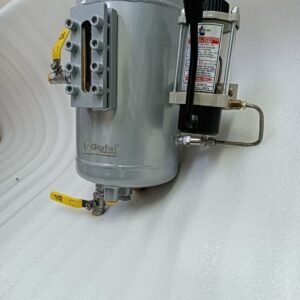
Reviews
There are no reviews yet.