Autoclaves & Polycondensation Autoclaves
Process Overview
Autoclaves & Polycondensation Autoclaves — Sealing Overview
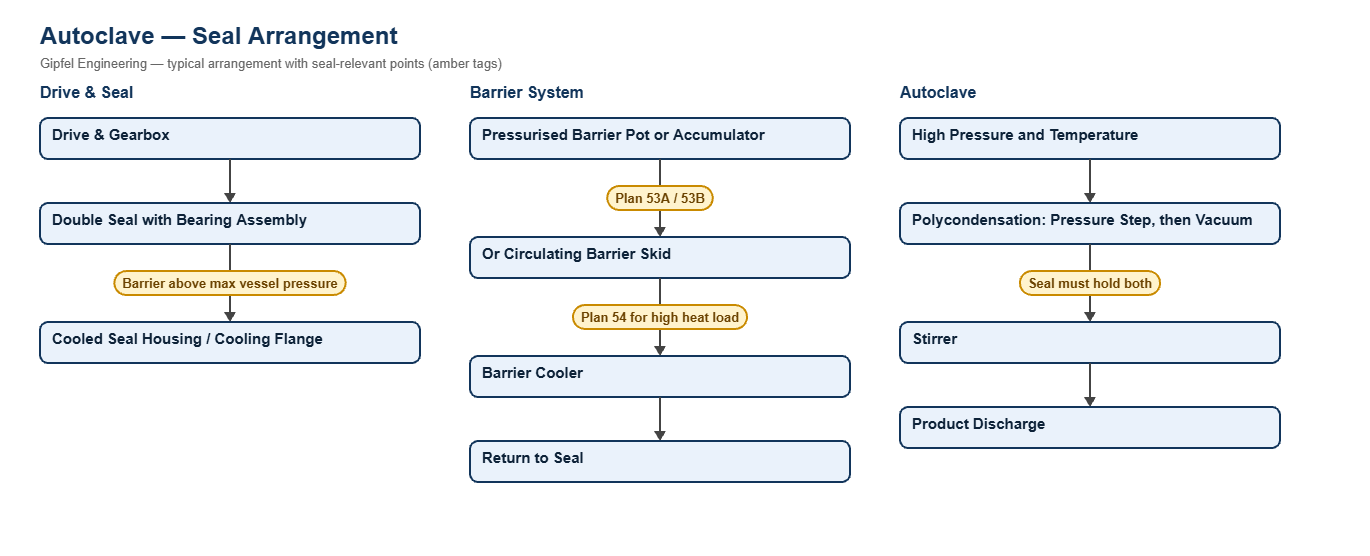
Autoclaves are stirred pressure vessels for reactions that need high pressure and temperature: hydrothermal synthesis, pressure leaching, catalyst work and batch polymerisation. Polycondensation autoclaves make polyamide and polyester in batches, running first under pressure and then under vacuum at polymer melt temperature.
The seal must contain the vessel at its highest pressure, keep air out under vacuum, and survive temperatures that exceed most elastomers. The usual answer is a pressurised double seal with its own bearing, a cooled seal housing that keeps the seal well below vessel temperature, and a barrier system held at least 1.4 bar above the highest vessel pressure. At the highest temperatures, metal bellows with flexible graphite replace elastomeric secondary seals.
Key Sealing Challenges
- Pressure: barrier pressure must exceed vessel pressure through every step of the batch. A bladder accumulator (Plan 53B) or circulating system (Plan 54) suits higher pressures.
- Temperature: a cooling flange or cooled housing keeps the faces and secondary seals within their limits.
- Pressure-then-vacuum cycles: polycondensation seals must hold pressure and vacuum in the same batch.
- Polymer at the faces: melt that reaches the faces hardens. Keep barrier pressure above vessel pressure and choose a barrier fluid compatible with the polymer.
Which mechanical seal suits a high-pressure autoclave?
Use a pressurised double seal with bearing assembly and a cooled seal housing, with the barrier held at least 1.4 bar above maximum vessel pressure on Plan 53A, 53B or 54. For hot polycondensation autoclaves, use a dual metal bellows seal with flexible graphite on a cooled circulating barrier.
Fault Diagnosis Example
Symptom: Polycondensation autoclave seal leaks after the vacuum stage; hardened polymer is found on the faces.
  ├── Incorrect Response: "Fit a stronger spring."
  ├── Diagnostic Evidence Required:
  │     ├── Did barrier pressure stay above vessel pressure through the pressure stage?
  │     ├── Is the seal housing cooling working; what is the seal temperature during melt?
  │     └── Is the barrier fluid compatible with the polymer at operating temperature?
  └── Engineered Solution:
        ├── Hold barrier pressure at least 1.4 bar above peak vessel pressure, with alarms.
        ├── Restore cooling to the seal housing and barrier cooler.
        └── Use metal bellows with flexible graphite where elastomers exceed their limits.
Frequently Asked Questions
Why does an autoclave seal need a cooled housing?
Vessel temperature often exceeds the limits of seal faces and secondary seals. A cooling flange or cooled housing, together with a cooled barrier, keeps the seal within its own limits while the vessel runs hot.
Can an autoclave use a magnetic drive instead of a seal?
On small laboratory and pilot autoclaves, magnetic drives are common. Production autoclaves with large shafts and high torque normally use pressurised double mechanical seals.
Related: Chemical & Glass-Lined Reactors · Agitators · Polymer & Rubber · All autoclave solutions.
Request a Seal Selection
Send the autoclave drawing, shaft size and speed, design pressure and temperature, and the product to info@gipfelengg.com or use our enquiry form. Gipfel Engineering (ISO 9001:2015, NSIC-registered MSME, Mumbai) designs and manufactures mechanical seals, seal support systems and process pumps.
Autoclave Duty & Mechanical Seal Selection Matrix
Typical values for selection guidance only. Final selection is made against the autoclave drawing, design pressure, design temperature and product.
| Autoclave type / duty | Typical equipment | Typical conditions | Seal arrangement | Faces / secondary seals | Barrier / piping plan |
|---|---|---|---|---|---|
| Stirred pressure autoclave — hydrothermal synthesis, leaching, pressure reactions | Stirred autoclaves and pressure reactors | High pressure; elevated temperature; seal must stay within its own temperature limit | Double seal with bearing assembly with cooled seal housing | SiC vs carbon or SiC vs SiC; FFKM within its temperature limit | Barrier ≥ 1.4 bar above maximum vessel pressure: Plan 53A, or Plan 53B (bladder accumulator) at higher pressures |
| Polycondensation autoclave — polyamide and polyester batches | Polycondensation autoclaves | Pressure stage followed by a vacuum stage at polymer melt temperature; product hardens if it reaches the faces | Dual metal bellows double cartridge seal with cooled seal housing | SiC vs carbon; flexible graphite secondary seals | Circulating cooled barrier (Plan 54) with a high-temperature barrier fluid compatible with the polymer |
| Laboratory and pilot autoclaves | Small autoclaves | Small shafts; frequent pressure and temperature cycling | Compact double seal to the vessel drawing (on request); magnetic drives are an alternative on small vessels | SiC vs carbon; FFKM | Pressurised barrier above vessel pressure |
Reviewed by Gipfel Engineering’s technical team.
Technical Information Disclaimer
The information on this page, including process descriptions, flow diagrams, operating ranges, seal arrangements, materials and piping plans, is general technical guidance for information only. Values shown are typical industry ranges, not guaranteed ratings or specifications of any Gipfel Engineering product. Each application differs. Seal selection, material compatibility, installation and operation must be verified by qualified personnel against the specific equipment data sheet, process conditions, applicable codes and the pump manufacturer’s instructions. A binding recommendation is given only in a written quotation or technical offer from Gipfel Engineering.
References to standards (such as API 682, ISO 21049, ISO 3069, FDA 21 CFR 177.2600 and NACE MR0175 / ISO 15156) describe common industry practice. They do not mean that any product is certified, qualified or approved to that standard unless this is confirmed in writing for a specific order. Third-party company and product names, including “equivalent to” references, are used for identification only and remain the trademarks of their owners. No affiliation, endorsement or OEM approval is implied.
Compliance with safety, hazardous-area, environmental and statutory requirements at the user’s site remains the responsibility of the plant owner or operator. To the extent permitted by law, Gipfel Engineering accepts no liability for loss or damage arising from reliance on this general information without a confirmed written recommendation. Content may change without notice.