
Fermenters & Bioreactors
Process Overview
Fermenters & Bioreactors — Sealing Overview
Fermenters and bioreactors grow microorganisms or cells in a sterile, agitated and aerated broth. They make antibiotics, enzymes, vaccines, amino acids and food cultures, from laboratory and seed vessels up to large production fermenters with top- or bottom-entry agitators.
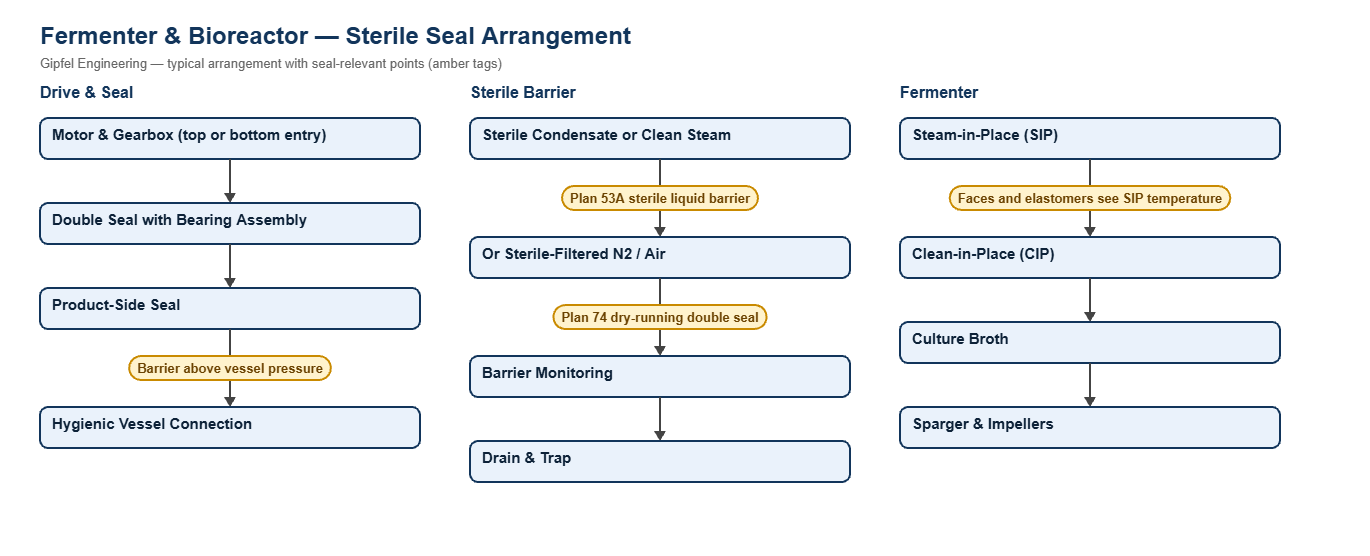
Sterility decides the seal design. A single contaminating organism entering past the seal can ruin a batch that took days to grow. The seal therefore must keep the vessel sealed against the outside, survive steam-in-place (SIP) and clean-in-place (CIP) cycles, and use only materials that are acceptable in contact with the product. The normal arrangement is a double seal whose barrier is itself sterile, either condensate or clean steam (API Plan 53A), or sterile-filtered gas on a dry-running seal (Plan 74), held above vessel pressure so any leakage is sterile barrier into the vessel, never outside air in.
Key Sealing Challenges
- Sterility: the barrier between the faces must be sterile and above vessel pressure at all times, including during SIP and cool-down when vessel pressure changes.
- Steam-in-place: faces and elastomers go through repeated heating to sterilising temperature and back. Peroxide-cured EPDM or FFKM and SiC vs carbon faces cope well with this cycling.
- Cleanability: product-side parts must drain and clean fully, without crevices where broth can lodge.
- Materials: elastomers to FDA 21 CFR 177.2600 or USP Class VI, and resin-impregnated (not antimony-impregnated) carbon.
Which mechanical seal suits a fermenter?
Fermenters normally use a double seal with a sterile barrier held above vessel pressure: sterile condensate or clean steam on Plan 53A, or sterile-filtered nitrogen or air on a dry-running double seal (Plan 74). Use SiC vs resin-impregnated carbon faces and FDA 21 CFR 177.2600 or USP Class VI elastomers that withstand repeated SIP.
Fault Diagnosis Example
Symptom: Fermenter batches are contaminated intermittently; the agitator seal shows no visible leak.
  ├── Incorrect Response: "The seal is dry, so it cannot be the cause."
  ├── Diagnostic Evidence Required:
  │     ├── Log barrier pressure against vessel pressure through SIP, cool-down and fermentation; does vessel pressure ever exceed the barrier?
  │     ├── Is the barrier itself sterile (condensate source, sterile filter condition)?
  │     └── Inspect product-side parts for crevices where broth lodges after CIP.
  └── Engineered Solution:
        ├── Keep the sterile barrier above vessel pressure in every phase, with alarms.
        ├── Replace sterile filters and validate the barrier source.
        └── Use a crevice-free, drainable product-side seal design.
Frequently Asked Questions
Why does a fermenter need a double seal?
A single seal leaks a little across its faces in normal running, and that path could let organisms in. A double seal puts a sterile barrier between the faces at higher pressure than the vessel, so the only flow is sterile barrier into the vessel.
Which barrier is better: condensate, steam or gas?
Sterile condensate or clean steam suits most production fermenters and cools the faces. A sterile gas barrier on a dry-running seal avoids any liquid entering the batch and suits vessels where dilution or wetting is unacceptable.
Do fermenter seals need FDA-compliant materials?
Yes. Elastomers in contact with product or barrier should comply with FDA 21 CFR 177.2600 or USP Class VI, and carbon faces should be resin-impregnated rather than antimony-impregnated. Confirm material certificates against your validation requirements.
Related: Biotech & Sterile Manufacturing · Agitators · Chemical & Glass-Lined Reactors · All fermenter solutions.
Request a Seal Selection
Send the fermenter drawings, shaft size and speed, vessel design pressure, SIP temperature and validation requirements to info@gipfelengg.com or use our enquiry form. Gipfel Engineering (ISO 9001:2015, NSIC-registered MSME, Mumbai) designs and manufactures mechanical seals, seal support systems and process pumps.
Fermenter & Bioreactor Duty & Mechanical Seal Selection Matrix
Typical values for selection guidance only. Final selection is made against the vessel drawings, SIP and CIP conditions and the customer’s validation requirements.
| Fermenter type / duty | Typical equipment | Typical conditions | Seal arrangement | Faces / elastomer | Barrier / piping plan |
|---|---|---|---|---|---|
| Production fermenter — top entry | Industrial bio-fermenters (antibiotics, enzymes, vaccines, food cultures) | Sterile broth; aeration; SIP with clean steam and CIP between batches | Double seal with bearing assembly with sterile barrier | SiC vs resin-impregnated carbon; peroxide-cured EPDM or FFKM to FDA 21 CFR 177.2600 / USP Class VI | Plan 53A with sterile condensate or clean steam, held above vessel pressure |
| Fermenter where a liquid barrier is not acceptable | Pharmaceutical and biotech fermenters | Barrier must not dilute or contaminate the batch | Double dry-running seal for fermenters & bioreactors | Gas-lubricated faces to the seal datasheet; FDA-compliant elastomers | Plan 74 with sterile-filtered nitrogen or air above vessel pressure |
| Bottom-entry fermenter and bioreactor | Bottom-driven bioreactors | Seal is submerged in broth; must drain fully and sterilise with the vessel | Double seal with bearing assembly with sterile barrier | SiC vs SiC or SiC vs carbon; FDA-compliant elastomers | Plan 53A sterile barrier above vessel pressure plus liquid head |
| Seed and laboratory fermenters | Seed vessels and lab fermenters | Small shafts; frequent sterilisation | Compact double seal to the vessel drawing (on request); magnetic drives are an alternative on small vessels | SiC vs carbon; FDA-compliant elastomers | Sterile barrier to suit the design |
Reviewed by Gipfel Engineering’s technical team.
Technical Information Disclaimer
The information on this page, including process descriptions, flow diagrams, operating ranges, seal arrangements, materials and piping plans, is general technical guidance for information only. Values shown are typical industry ranges, not guaranteed ratings or specifications of any Gipfel Engineering product. Each application differs. Seal selection, material compatibility, installation and operation must be verified by qualified personnel against the specific equipment data sheet, process conditions, applicable codes and the pump manufacturer’s instructions. A binding recommendation is given only in a written quotation or technical offer from Gipfel Engineering.
References to standards (such as API 682, ISO 21049, ISO 3069, FDA 21 CFR 177.2600 and NACE MR0175 / ISO 15156) describe common industry practice. They do not mean that any product is certified, qualified or approved to that standard unless this is confirmed in writing for a specific order. Third-party company and product names, including “equivalent to” references, are used for identification only and remain the trademarks of their owners. No affiliation, endorsement or OEM approval is implied.
Compliance with safety, hazardous-area, environmental and statutory requirements at the user’s site remains the responsibility of the plant owner or operator. To the extent permitted by law, Gipfel Engineering accepts no liability for loss or damage arising from reliance on this general information without a confirmed written recommendation. Content may change without notice.