Alumina & Non-Ferrous Metals
Process Overview
Alumina & Non-Ferrous Metals — Process Overview
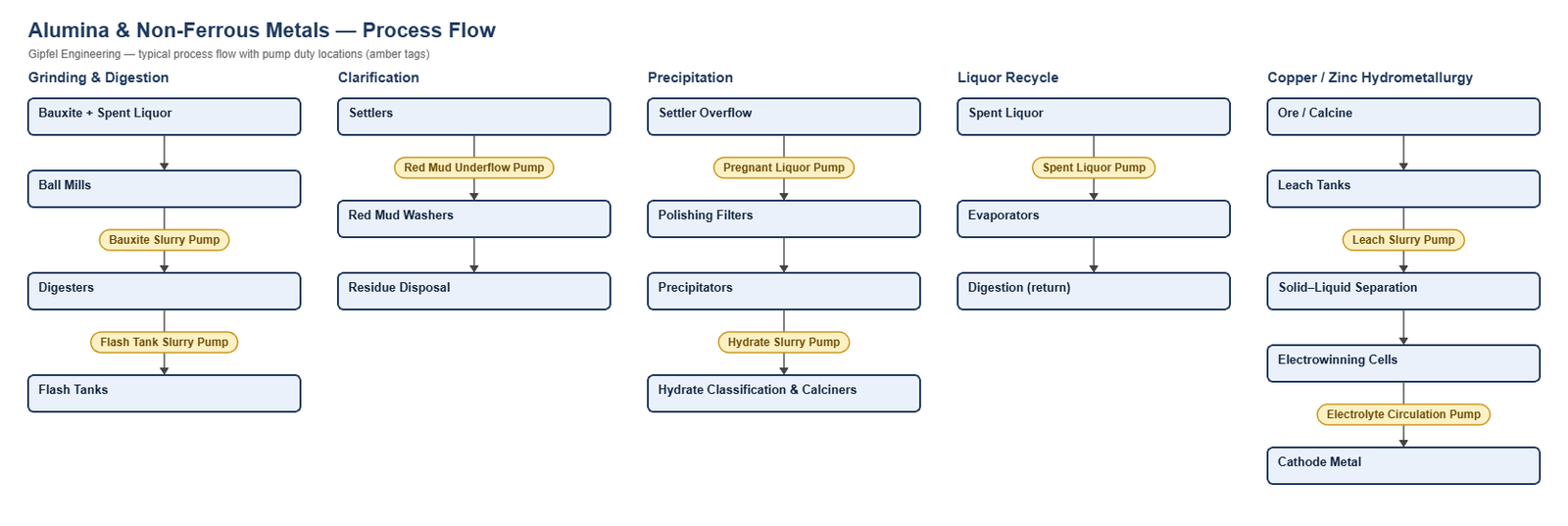
In the Bayer process, bauxite is ground with hot caustic liquor and digested to dissolve alumina, leaving red mud that is settled, washed and sent to residue disposal. The clarified pregnant liquor is filtered and cooled in precipitators, where aluminium hydroxide (hydrate) crystallises; the hydrate is classified and calcined to alumina, and the spent liquor is evaporated and recycled to digestion. Copper and zinc plants leach ore or calcine with sulphuric acid and recover the metal by electrowinning.
For iron and steel making see Integrated Steel Plant; for ore slurry and mineral processing see Mining Slurry.
Key Sealing Challenges
- Hot caustic: Bayer liquor attacks the free silicon in reaction-bonded SiC; sintered SiC faces are specified throughout.
- Abrasion: bauxite, red mud and hydrate slurries need hard face pairs and springs kept out of the product.
- Scaling: supersaturated liquor scales on the faces and atmospheric side; condensate flush and quench control it.
- Acid circuits: copper and zinc leach and electrolyte need Alloy 20 or Hastelloy C metal parts.
What mechanical seal is used on red mud and Bayer slurry pumps?
Red mud and bauxite slurry pumps typically use a slurry cartridge seal with external springs (e.g. Gipfel HS860) and sintered SiC vs. sintered SiC faces on an API Plan 32 condensate flush. Sintered SiC resists the hot caustic, which leaches reaction-bonded SiC, and the condensate flush keeps abrasive mud and scale off the faces without adding impurities to the liquor.
Root-Cause Failure Analysis — Field Example
Symptom: Pregnant liquor pump seal leaks after a few weeks; white scale on the faces and atmospheric side.
  ├── Incorrect Response: "Increase spring load."
  ├── Diagnostic Evidence Required:
  │     ├── Is supersaturated liquor scaling on the faces as it cools?
  │     ├── Is a condensate flush and quench fitted and flowing?
  │     └── Check face material: reaction-bonded SiC attacked by caustic?
  └── Engineered Solution:
        ├── API Plan 32 condensate flush with a Plan 62 quench.
        ├── Sintered SiC vs sintered SiC faces.
        └── Keep the quench running during stops.
Frequently Asked Questions
Why use condensate as flush in alumina refineries?
Condensate is clean, hot and compatible with Bayer liquor. It does not dilute the circuit with outside water or add impurities, and it dissolves scale-forming liquor at the seal.
Which seal suits zinc and copper electrolyte pumps?
A balanced cartridge seal with sintered SiC faces, FKM elastomers and Alloy 20 or Hastelloy C metal parts on an API Plan 11 flush resists the sulphuric acid electrolyte.
Related: Integrated Steel Plant · Mining Slurry · Sulphuric Acid · Chlor-Alkali.
Request a Seal Selection
Send your pump make and model, fluid, temperature, pressure, shaft size and speed to info@gipfelengg.com or use our enquiry form. Gipfel Engineering (ISO 9001:2015, NSIC-registered MSME, Mumbai) designs and manufactures mechanical seals, seal support systems and process pumps.
Equipment solutions: Slurry Pumps · Agitators · Autoclaves.
Pump Duty & Mechanical Seal Selection Matrix
Typical values for selection guidance only. Final selection is made against the customer duty sheet.
| Pump duty | Fluid | Typical temp. | Typical pressure (bar) | Seal arrangement | Faces / elastomer | API piping plan |
|---|---|---|---|---|---|---|
| Bauxite Slurry Pump (digestion feed) | Bauxite in caustic liquor, abrasive | 60–100 °C | 3–8 bar | Slurry cartridge, external springs (catalogue ref. HS860) | Sintered SiC vs sintered SiC / EPDM | API Plan 32 (condensate flush) |
| Flash Tank / Digested Slurry Pump | Hot caustic slurry | 100–150 °C | Seal-chamber pressure — confirm per pump | Double cartridge, back-to-back (pressurised) | Sintered SiC vs sintered SiC / EPDM (peroxide-cured) or FFKM | API Plan 53A (condensate barrier ≥ 1.4 bar above seal chamber) |
| Red Mud Underflow / Washer Pump | Red mud slurry, caustic and abrasive | 80–100 °C | 2–6 bar | Slurry cartridge, external springs (catalogue ref. HS860) | Sintered SiC vs sintered SiC / EPDM | API Plan 32 (condensate flush) |
| Pregnant Liquor Pump | Supersaturated sodium aluminate liquor, scaling | 90–105 °C | 3–6 bar | Balanced multi-spring cartridge | Sintered SiC vs sintered SiC / EPDM | API Plan 32 (condensate flush) + Plan 62 quench against scaling |
| Hydrate Slurry Pump (precipitation) | Aluminium hydroxide slurry | 60–80 °C | 2–5 bar | Slurry cartridge, external springs (catalogue ref. HS860) | Sintered SiC vs sintered SiC / EPDM | API Plan 32 |
| Spent Liquor / Evaporator Pump | Caustic spent liquor | 70–120 °C | 3–6 bar | Balanced multi-spring cartridge | Sintered SiC vs sintered SiC / EPDM | API Plan 11 + Plan 62 water quench |
| Copper / Zinc Leach Slurry Pump | Acidic (H₂SO₄) leach slurry | 40–80 °C | 2–5 bar | Slurry cartridge, external springs (catalogue ref. HS860) with Alloy 20 or Hastelloy C-276 metal parts | Sintered SiC vs sintered SiC / FKM | API Plan 32 |
| Electrolyte Circulation Pump (electrowinning) | Sulphuric acid electrolyte with metal ions | 40–60 °C | 2–4 bar | Balanced multi-spring cartridge with Alloy 20 or Hastelloy C-276 metal parts | Sintered SiC vs sintered SiC / FKM | API Plan 11 |
| Smelter / Casting Cooling Water Pump | Soft or DM cooling water | 30–50 °C | 4–10 bar | Balanced multi-spring cartridge | SiC vs carbon / EPDM | API Plan 11 |
Reviewed by Gipfel Engineering’s technical team.
Technical Information Disclaimer
The information on this page, including process descriptions, flow diagrams, operating ranges, seal arrangements, materials and piping plans, is general technical guidance for information only. Values shown are typical industry ranges, not guaranteed ratings or specifications of any Gipfel Engineering product. Each application differs. Seal selection, material compatibility, installation and operation must be verified by qualified personnel against the specific equipment data sheet, process conditions, applicable codes and the pump manufacturer’s instructions. A binding recommendation is given only in a written quotation or technical offer from Gipfel Engineering.
References to standards (such as API 682, ISO 21049, ISO 3069, FDA 21 CFR 177.2600 and NACE MR0175 / ISO 15156) describe common industry practice. They do not mean that any product is certified, qualified or approved to that standard unless this is confirmed in writing for a specific order. Third-party company and product names, including “equivalent to” references, are used for identification only and remain the trademarks of their owners. No affiliation, endorsement or OEM approval is implied.
Compliance with safety, hazardous-area, environmental and statutory requirements at the user’s site remains the responsibility of the plant owner or operator. To the extent permitted by law, Gipfel Engineering accepts no liability for loss or damage arising from reliance on this general information without a confirmed written recommendation. Content may change without notice.