
Positive Displacement Pumps
Process Overview
Positive Displacement Pumps — Sealing Overview
Positive displacement (PD) pumps move a fixed volume per revolution. Progressive cavity, rotary lobe, gear and screw pumps handle what centrifugal pumps cannot: high viscosity, shear-sensitive food products, sludges and slurries, and products that must be dosed at a steady rate. API 676 covers rotary PD pumps for the process industries.
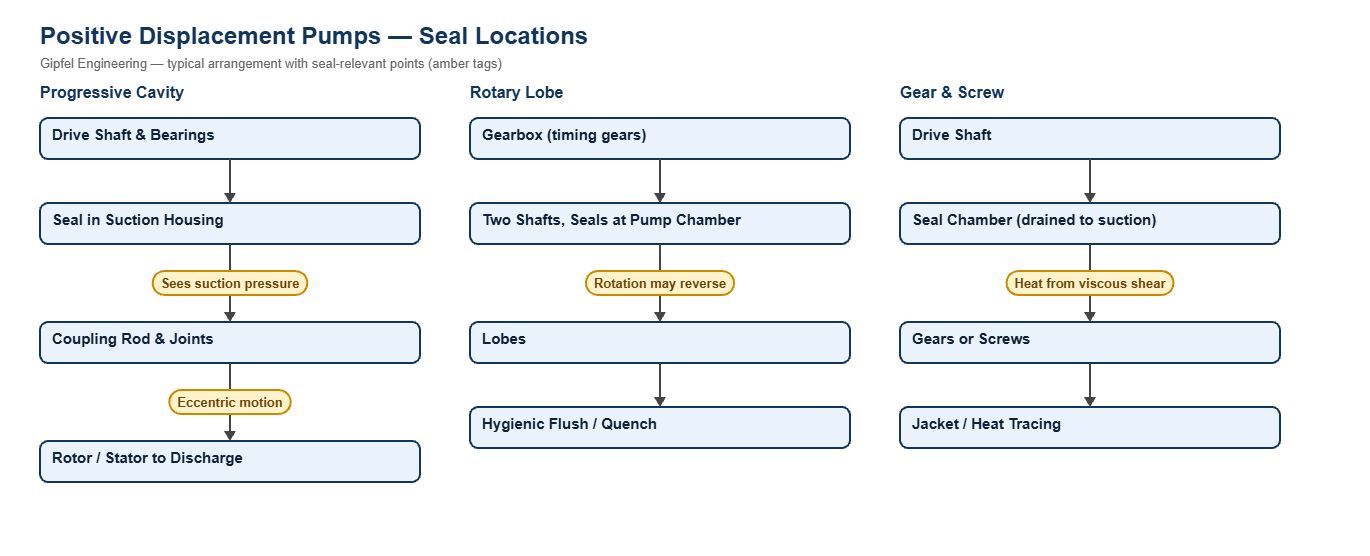
The seal duty differs from a centrifugal pump in three ways. Speeds are low, so the faces generate little heat from speed, but viscous products shear in the seal chamber and can overheat it. On progressive cavity pumps and most gear and screw pumps the seal sits on the suction side and sees suction pressure. And many PD pumps run in both directions, so the seal must not rely on a direction-sensitive pumping feature.
Key Sealing Challenges
- Viscosity: thick products drag on the rotating parts and can stop springs from following the faces. Balanced seals with springs outside the product cope better.
- Products that harden: sugar syrups, resins, bitumen and polymers set on the atmospheric side as they cool or dry. A Plan 62 water or steam quench keeps the faces free.
- Reversing rotation: lobe pumps are often reversed for cleaning or emptying lines. Seals must be bi-directional.
- Hygiene: food and pharmaceutical duties need cleanable seal designs, FDA-compliant elastomers and resin-impregnated (not antimony) carbon.
Which mechanical seal suits a positive displacement pump?
Use a balanced, bi-directional cartridge seal sized for the pressure at the seal (usually suction pressure on progressive cavity and gear pumps). Add a Plan 62 quench where the product hardens, a metal bellows seal with steam quench for hot bitumen or resins, and FDA-compliant materials on hygienic lobe pumps.
Fault Diagnosis Example
Symptom: Seal on a molasses gear pump leaks after every weekend shutdown.
  ├── Incorrect Response: "Increase spring force."
  ├── Diagnostic Evidence Required:
  │     ├── Is there hardened product on the atmospheric side of the faces?
  │     ├── Is the seal housing heat-traced, and was the quench left on during shutdown?
  │     └── Are the faces chipped from starting against set product?
  └── Engineered Solution:
        ├── Fit a Plan 62 steam or hot-water quench and keep it on during shutdown.
        ├── Heat the pump and seal housing before start-up.
        └── Use SiC vs SiC faces, which resist chipping.
Frequently Asked Questions
What pressure does the seal on a progressive cavity pump see?
In the standard arrangement the seal is in the suction housing, so it sees suction pressure, not the discharge pressure the pump develops. Confirm the arrangement, because some designs are reversed.
Why do lobe pumps need bi-directional seals?
Lobe pumps are often run backwards to empty lines or to clean. A seal with a direction-sensitive pumping feature can run dry or unload its faces in reverse.
Can a gear pump running on packing be converted to a mechanical seal?
Usually yes, if the stuffing box is deep enough for a cartridge or component seal. Send the pump make, model and stuffing-box dimensions.
Related: Beverage & Brewery · Polymer & Rubber · Molasses-Based Distillery · Slurry Pumps · All process pump solutions.
Request a Seal Selection
Send your pump make and model, product, viscosity, temperature, pressure, shaft size and speed to info@gipfelengg.com or use our enquiry form. Gipfel Engineering (ISO 9001:2015, NSIC-registered MSME, Mumbai) designs and manufactures mechanical seals, seal support systems and process pumps.
Positive Displacement Pump Duty & Mechanical Seal Selection Matrix
Typical values for selection guidance only. Final selection is made against the pump data sheet and seal-chamber dimensions.
| Pump type / duty | Typical makes & models | Typical conditions | Seal arrangement | Faces / elastomer | API piping plan |
|---|---|---|---|---|---|
| Progressive cavity pump — sludge, slurry and viscous products | Progressive cavity pumps (model to confirm) | Seal in the suction housing at suction pressure; 50–400 rpm; solids and fibres common | Slurry cartridge seal, external springs (catalogue ref. HS860) or Balanced multi-spring cartridge seal | SiC vs SiC; EPDM, FKM or NBR to suit the product | Plan 62 quench; Plan 32 on abrasive or fibrous products |
| Rotary lobe pump — food, dairy and hygienic duty | Rotary lobe pumps (model to confirm) | Two shafts; rotation may be reversed for flushing or emptying; CIP and SIP cycles | Hygienic single or double seal suited to both directions of rotation (on request) | SiC vs SiC or SiC vs resin-impregnated carbon; EPDM or FKM to FDA 21 CFR 177.2600 | Plan 62 water or steam quench on sugary, sticky or crystallising products |
| External gear pump — oils, resins and polymers | Gear pumps (model to confirm) | Viscous products; heat from shear in the seal chamber; heated jackets | Balanced multi-spring cartridge seal; Stationary metal bellows cartridge seal above about 260 °C | SiC vs carbon; FKM, FFKM or flexible graphite (bellows) | Plan 62 steam quench where the product solidifies on cooling |
| Internal gear pump — bitumen, molasses and heavy fuels | Internal gear pumps (model to confirm) | Hot, viscous products that harden at ambient temperature | Stationary metal bellows cartridge seal | SiC vs carbon or SiC vs SiC; flexible graphite | Plan 62 steam quench; heat-trace the seal housing |
| Twin- and three-screw pump — lube oil, fuel oil and crude transfer | Screw pumps (model to confirm) | Clean or lightly contaminated oils | Balanced multi-spring cartridge seal; Double cartridge seal, back-to-back (pressurised) on hazardous hydrocarbons | SiC vs carbon; FKM | Plan 11 or dead-ended on clean oil; Plan 53A on hazardous fluids |
Reviewed by Gipfel Engineering’s technical team.
Technical Information Disclaimer
The information on this page, including process descriptions, flow diagrams, operating ranges, seal arrangements, materials and piping plans, is general technical guidance for information only. Values shown are typical industry ranges, not guaranteed ratings or specifications of any Gipfel Engineering product. Each application differs. Seal selection, material compatibility, installation and operation must be verified by qualified personnel against the specific equipment data sheet, process conditions, applicable codes and the pump manufacturer’s instructions. A binding recommendation is given only in a written quotation or technical offer from Gipfel Engineering.
References to standards (such as API 682, ISO 21049, ISO 3069, FDA 21 CFR 177.2600 and NACE MR0175 / ISO 15156) describe common industry practice. They do not mean that any product is certified, qualified or approved to that standard unless this is confirmed in writing for a specific order. Third-party company and product names, including “equivalent to” references, are used for identification only and remain the trademarks of their owners. No affiliation, endorsement or OEM approval is implied.
Compliance with safety, hazardous-area, environmental and statutory requirements at the user’s site remains the responsibility of the plant owner or operator. To the extent permitted by law, Gipfel Engineering accepts no liability for loss or damage arising from reliance on this general information without a confirmed written recommendation. Content may change without notice.