
Industrial Blowers
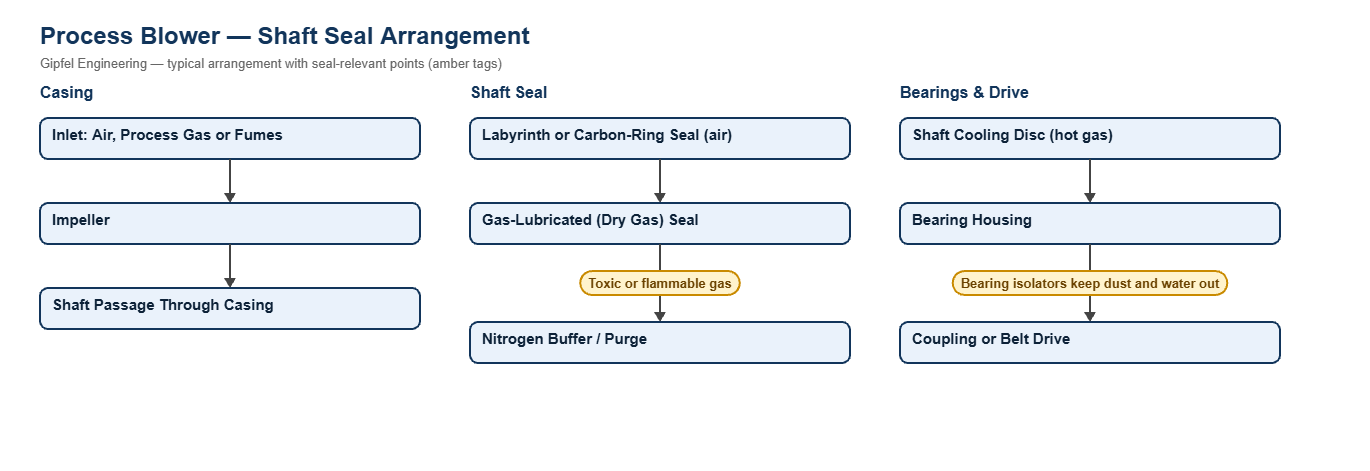
Process Overview
Industrial Blowers — Sealing Overview
Industrial blowers move air and process gases: hot air and dryer exhaust blowers, induced-draft fans, air-classifier and pneumatic-conveying blowers, FRP blowers for corrosive fume extraction, and centrifugal blowers for process gases such as biogas, hydrogen-rich streams or solvent-laden air.
The right shaft seal depends on what may leak. On air and flue-gas blowers some leakage is acceptable, so labyrinth or carbon-ring seals with a shaft cooling disc are normal, and the main task is to protect the bearings. Where the gas is toxic, flammable or valuable, it must be contained, and a gas-lubricated (dry gas) seal with a nitrogen buffer keeps the process gas in and air out. A liquid-lubricated mechanical seal is not used on a gas-only shaft because there is no liquid to lubricate its faces.
Key Sealing Challenges
- No liquid at the faces: only gas-lubricated or non-contacting seals suit continuous gas duty at blower speeds.
- Heat: hot gas heats the shaft towards the bearings; shaft cooling discs and bearing isolators protect them.
- Corrosion: acid fumes attack metal seal parts, so non-metallic wetted parts and a purge are used.
- Dust: classifier and conveying blowers carry fine dust that reaches bearings unless purged and isolated.
Which shaft seal suits a process blower?
On toxic, flammable or valuable gas, use a gas-lubricated (dry gas) seal with a nitrogen buffer. On air and flue gas, a labyrinth or carbon-ring seal with a shaft cooling disc is normal, with bearing isolators on the bearing housings. Corrosive fume blowers need non-metallic seal parts and a purge.
Fault Diagnosis Example
Symptom: Bearings on a hot-air blower fail every few months; the oil is dark and contains dust.
  ├── Incorrect Response: "Change the bearings more often."
  ├── Diagnostic Evidence Required:
  │     ├── What seals the bearing housings: lip seals worn into the shaft?
  │     ├── Is the shaft cooling disc in place and clean?
  │     └── Is hot, dusty gas escaping along the shaft towards the bearings?
  └── Engineered Solution:
        ├── Fit non-contacting bearing isolators on both bearing housings.
        ├── Restore the shaft cooling disc and the casing shaft seal.
        └── Add a small purge where dust escapes at the shaft passage.
Frequently Asked Questions
Can a standard mechanical seal be used on a blower?
Not on a gas-only shaft running continuously at blower speed. A liquid-lubricated seal needs liquid at its faces. Gas duty uses gas-lubricated seals, or labyrinth and carbon-ring seals where some leakage is acceptable.
Why fit bearing isolators to a blower?
Lip seals wear into the shaft and let in dust and moisture. Non-contacting bearing isolators do not wear and keep the bearing oil clean, which is often the biggest single gain in blower reliability.
Related: Compressors & Bearing Chambers · Compressed Biogas & 2G Ethanol · All blower solutions.
Request a Seal Selection
Send the blower drawing, shaft size and speed, gas composition, casing pressure and temperature to info@gipfelengg.com or use our enquiry form. Gipfel Engineering (ISO 9001:2015, NSIC-registered MSME, Mumbai) designs and manufactures mechanical seals, seal support systems and process pumps.
Blower Duty & Shaft Seal Selection Matrix
Typical values for selection guidance only. Final selection is made against the blower drawing, gas composition, casing pressure and temperature.
| Blower type / duty | Typical equipment | Typical conditions | Seal arrangement | Seal materials | Buffer / purge |
|---|---|---|---|---|---|
| Process gas blower — toxic, flammable or valuable gas | Centrifugal process gas blowers | Gas must be kept in and air kept out; casing at pressure or slight vacuum | Gas-lubricated (dry gas) seal | Gas-lubricated faces to the seal datasheet | Nitrogen buffer or barrier, arranged to the blower maker’s design (Plan 74 type supply) |
| Hot air and flue-gas blower | Hot air, dryer exhaust and ID blowers | Hot gas at the shaft passage; leakage of air is usually acceptable | Labyrinth or carbon-ring shaft seal to the blower drawing (on request), with a shaft cooling disc; Split bearing isolator on the bearing housings | Carbon or metallic labyrinth | Bearing isolators keep heat-borne dust and moisture out of the bearings |
| FRP blower — corrosive fumes | Fume extraction blowers (HCl, chlorine, acid fumes) | Corrosive fumes at the shaft passage; casing usually under slight suction | Shaft seal with non-metallic or PTFE wetted parts (on request) | PTFE or carbon; FFKM | Small air or nitrogen purge to keep fumes away from the seal and bearings |
| Air-classifier and pneumatic-conveying blower | Classifier fans and conveying blowers | Fine dust carried in the air stream | Labyrinth seal with purge (on request); Split bearing isolator on the bearing housings | — | Purge air keeps dust off the shaft passage and bearings |
Reviewed by Gipfel Engineering’s technical team.
Technical Information Disclaimer
The information on this page, including process descriptions, flow diagrams, operating ranges, seal arrangements, materials and piping plans, is general technical guidance for information only. Values shown are typical industry ranges, not guaranteed ratings or specifications of any Gipfel Engineering product. Each application differs. Seal selection, material compatibility, installation and operation must be verified by qualified personnel against the specific equipment data sheet, process conditions, applicable codes and the pump manufacturer’s instructions. A binding recommendation is given only in a written quotation or technical offer from Gipfel Engineering.
References to standards (such as API 682, ISO 21049, ISO 3069, FDA 21 CFR 177.2600 and NACE MR0175 / ISO 15156) describe common industry practice. They do not mean that any product is certified, qualified or approved to that standard unless this is confirmed in writing for a specific order. Third-party company and product names, including “equivalent to” references, are used for identification only and remain the trademarks of their owners. No affiliation, endorsement or OEM approval is implied.
Compliance with safety, hazardous-area, environmental and statutory requirements at the user’s site remains the responsibility of the plant owner or operator. To the extent permitted by law, Gipfel Engineering accepts no liability for loss or damage arising from reliance on this general information without a confirmed written recommendation. Content may change without notice.