
Industrial Dryers & ANFD
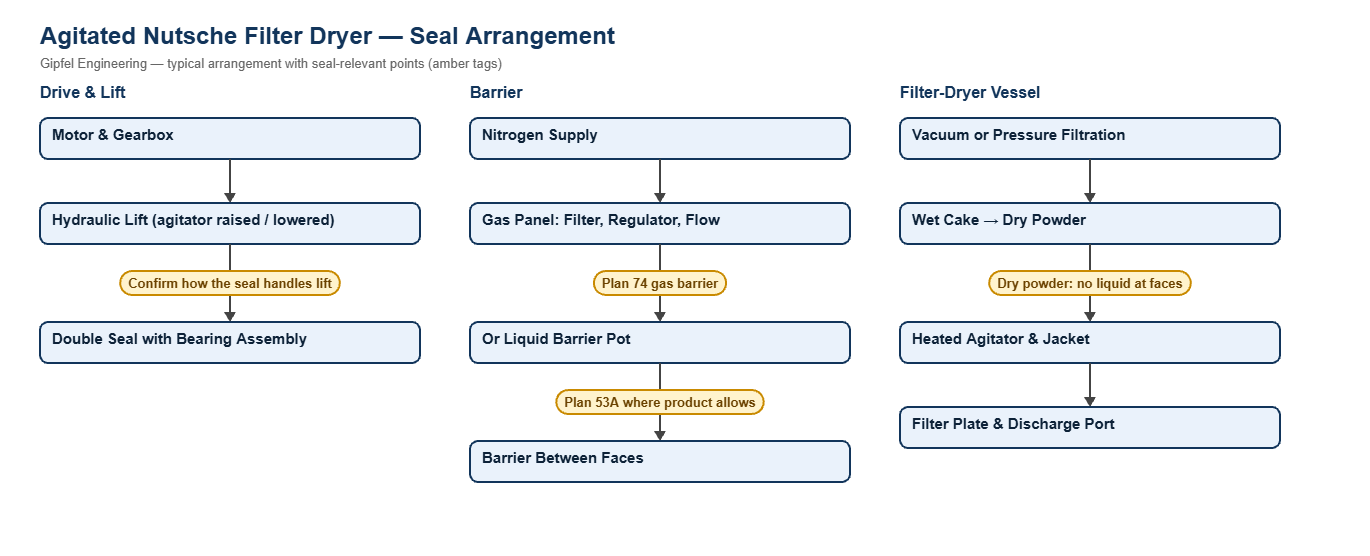
Process Overview
Industrial Dryers & ANFD — Sealing Overview
Industrial dryers remove solvent or water from wet solids. Agitated Nutsche filter dryers (ANFD) filter a slurry and then dry the cake in the same vessel; paddle and twin-shaft screw dryers move product along heated horizontal shafts under vacuum; agitated vacuum dryers, filter dryers, roto-cone (double-cone) dryers and drum dryers complete the range.
The seal duty ends in the hardest condition a seal can face: dry, fine powder under vacuum, with solvent vapour that may be toxic or flammable. There is no liquid to lubricate the faces. The usual answer is a double seal running on a dry gas barrier, normally nitrogen (API Plan 74), held above vessel pressure so powder and vapour stay inside. On ANFDs the agitator is also raised and lowered for discharge and cake smoothing; depending on the dryer design, the seal travels with the drive or must accept the shaft’s vertical movement, so this must be confirmed from the dryer drawing before selection.
Key Sealing Challenges
- Dry powder: fine powder works into the faces and secondary seals. A gas barrier above vessel pressure keeps it out.
- Vacuum and solvent vapour: the seal must keep air out and solvent in; double seals with a gas barrier do both.
- Heavy, slow shafts: paddle and screw dryer shafts deflect and run hot from the heated shaft. Seals with their own bearing support help.
- Product purity: a liquid barrier that leaks into a pharmaceutical batch spoils it; a nitrogen barrier does not.
Which mechanical seal suits an agitated Nutsche filter dryer?
An ANFD normally uses a double seal running on a dry nitrogen barrier (API Plan 74) held above vessel pressure, with FFKM or FDA-compliant elastomers. Confirm from the dryer drawing how the seal handles the agitator lift. A liquid barrier on Plan 53A is used only where the barrier fluid is acceptable in the product.
Fault Diagnosis Example
Symptom: ANFD seal leaks after the drying stage; powder is found between the faces.
  ├── Incorrect Response: "Use harder faces."
  ├── Diagnostic Evidence Required:
  │     ├── Was the nitrogen barrier on and above vessel pressure throughout drying and discharge?
  │     ├── Check the gas panel: filter condition, regulator setting and flow indication.
  │     └── How does the seal accommodate the agitator lift on this dryer?
  └── Engineered Solution:
        ├── Keep the Plan 74 barrier on whenever the agitator turns, with low-flow and low-pressure alarms.
        ├── Confirm the seal design matches the lift arrangement.
        └── Replace secondary seals with FFKM where solvents attack the existing elastomer.
Frequently Asked Questions
Why use a gas barrier instead of a liquid barrier on a dryer?
The product is a dry powder, often for pharmaceutical use. A liquid barrier that leaks inward contaminates the batch and wets the powder; a nitrogen barrier leaks only inert gas into the vessel.
Can a roto-cone dryer use a mechanical seal?
On a roto-cone or drum dryer the vessel itself rotates, so the sealing points are the trunnion connections for heating medium and vacuum. These use rotary joints selected for each medium.
How much nitrogen does a Plan 74 seal use?
Very little compared with a purge, because the gas only leaks across the seal faces. The flow depends on the seal size and barrier pressure; the seal datasheet gives the design value.
Related: Agitators · Chemical & Glass-Lined Reactors · API & Bulk Drug · All dryer solutions.
Request a Seal Selection
Send the dryer drawings, shaft size and speed, design pressure and vacuum level, temperature and product to info@gipfelengg.com or use our enquiry form. Gipfel Engineering (ISO 9001:2015, NSIC-registered MSME, Mumbai) designs and manufactures mechanical seals, seal support systems and process pumps.
Dryer & ANFD Duty & Mechanical Seal Selection Matrix
Typical values for selection guidance only. Final selection is made against the dryer drawings, design pressure, vacuum level, temperature and product.
| Dryer type / duty | Typical equipment | Typical conditions | Seal arrangement | Faces / elastomer | Barrier / piping plan |
|---|---|---|---|---|---|
| Agitated Nutsche filter dryer (ANFD) and filter dryer | Pharmaceutical, agrochemical and fine-chemical ANFDs | Vacuum and pressure filtration, then drying to powder; agitator raised and lowered; solvent vapours | Double dry-running seal (gas barrier) or Double seal with bearing assembly | Gas-lubricated or dry-running faces to the seal datasheet; FFKM or FDA-compliant elastomers | Plan 74 nitrogen barrier above vessel pressure; Plan 53A only where the barrier liquid is acceptable in the product |
| Rotary vacuum paddle dryer and twin-shaft screw dryer | Horizontal paddle and screw dryers | Slow, heavy horizontal shafts; vacuum; fine dry powders that work into the faces | Double dry-running seal (gas barrier) or Double seal with bearing assembly | Dry-running faces; FKM or FFKM | Plan 74 gas barrier; a gentle nitrogen purge keeps powder away from the faces |
| Vacuum dryer (agitated) — non-hazardous product | Agitated vacuum dryers | Vacuum only; no toxic vapours | Single dry-running seal with bearing support | Dry-running carbon vs SiC; FKM | Barrier not normally required; seal must hold vacuum |
| Roto-cone (double-cone) and drum dryer | Rotating-vessel and drum dryers | The whole vessel or drum rotates; heating and vacuum lines pass through the trunnions | Rotary joints for steam, hot water, thermal oil and vacuum connections | To suit the medium and temperature | Selected for each connection medium |
Reviewed by Gipfel Engineering’s technical team.
Technical Information Disclaimer
The information on this page, including process descriptions, flow diagrams, operating ranges, seal arrangements, materials and piping plans, is general technical guidance for information only. Values shown are typical industry ranges, not guaranteed ratings or specifications of any Gipfel Engineering product. Each application differs. Seal selection, material compatibility, installation and operation must be verified by qualified personnel against the specific equipment data sheet, process conditions, applicable codes and the pump manufacturer’s instructions. A binding recommendation is given only in a written quotation or technical offer from Gipfel Engineering.
References to standards (such as API 682, ISO 21049, ISO 3069, FDA 21 CFR 177.2600 and NACE MR0175 / ISO 15156) describe common industry practice. They do not mean that any product is certified, qualified or approved to that standard unless this is confirmed in writing for a specific order. Third-party company and product names, including “equivalent to” references, are used for identification only and remain the trademarks of their owners. No affiliation, endorsement or OEM approval is implied.
Compliance with safety, hazardous-area, environmental and statutory requirements at the user’s site remains the responsibility of the plant owner or operator. To the extent permitted by law, Gipfel Engineering accepts no liability for loss or damage arising from reliance on this general information without a confirmed written recommendation. Content may change without notice.