
Municipal Water & Sewage Treatment
Process Overview
Municipal Water & Sewage Treatment — Process Overview
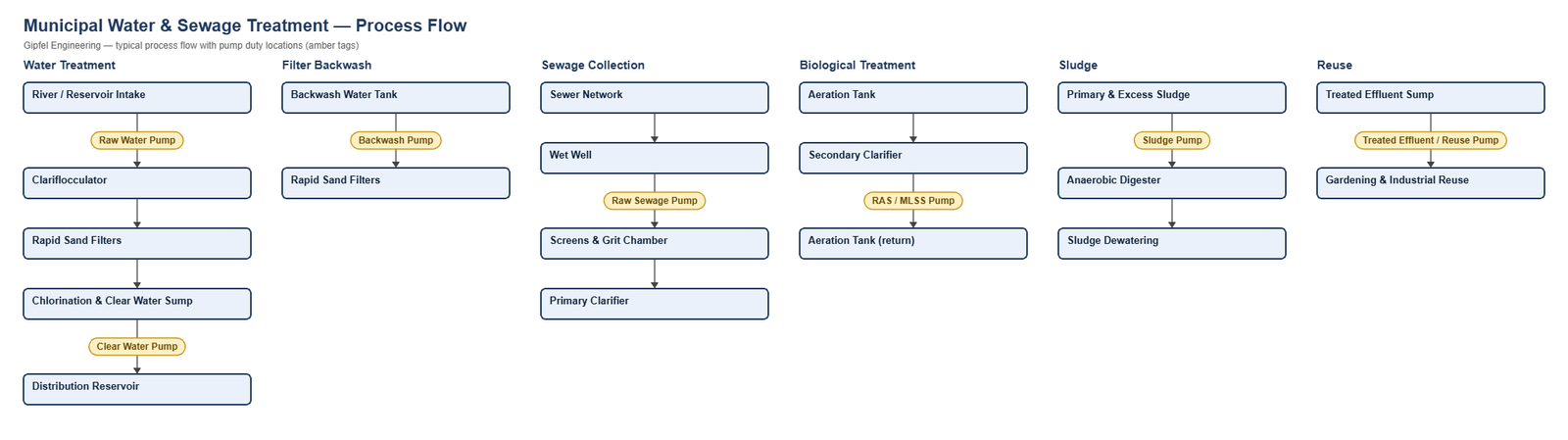
Municipal water treatment plants (WTP) draw raw water from rivers, lakes or reservoirs, clarify it in clariflocculators, filter it through rapid sand filters, disinfect it and pump it to distribution reservoirs. Sewage treatment plants (STP) lift raw sewage from wet wells, screen and de-grit it, settle it in primary clarifiers, treat it biologically in aeration tanks, and recycle activated sludge from secondary clarifiers. Sludge is digested and dewatered, and treated effluent is increasingly reused.
For industrial effluent and ZLD see Industrial ETP & ZLD; for seawater desalination see Desalination & RO.
Key Sealing Challenges
- Silt and grit: raw water and sewage carry abrasive particles; SiC vs SiC faces and a clean flush extend seal life.
- Rags and fibres: sewage wraps around exposed springs; slurry cartridges keep springs out of the product.
- Potable water: elastomers in contact with drinking water must be approved for potable use.
- Large pumps, long duty: intake and clear water pumps run continuously, and many are converted from gland packing to cartridge seals.
What mechanical seal is used on raw sewage pumps?
Submersible sewage pumps use the OEM’s two seals in an oil chamber, with a hard SiC vs. SiC (or tungsten carbide) lower seal facing the sewage. Dry-well sewage pumps use a slurry cartridge seal with springs out of the product and SiC vs. SiC faces, with an API Plan 32 treated-water flush where available.
Root-Cause Failure Analysis — Field Example
Symptom: Dry-well sewage pump seal fails every few weeks; springs wrapped with rags, faces scored.
  ├── Incorrect Response: "Fit a standard component seal with harder faces."
  ├── Diagnostic Evidence Required:
  │     ├── Are the springs exposed to the sewage and clogged with fibres?
  │     ├── Is grit reaching the faces with no flush?
  │     └── Check shaft run-out and bearing condition.
  └── Engineered Solution:
        ├── Slurry cartridge seal with springs out of the product.
        ├── SiC vs SiC faces with an API Plan 32 treated-water flush where available.
        └── Correct bearing condition and run-out.
Frequently Asked Questions
Can intake pumps be converted from gland packing to mechanical seals?
Yes, in most cases. A cartridge seal stops continuous gland leakage and sleeve wear; the stuffing box dimensions and shaft run-out are checked first, and silt-laden water needs a Plan 32 flush.
Why use SiC vs SiC on raw water pumps?
Silt particles embed in and wear carbon faces. A hard SiC pair resists abrasion and lasts much longer on unfiltered water.
Related: Industrial ETP & ZLD · Desalination & RO · Mining Slurry.
Request a Seal Selection
Send your pump make and model, fluid, temperature, pressure, shaft size and speed to info@gipfelengg.com or use our enquiry form. Gipfel Engineering (ISO 9001:2015, NSIC-registered MSME, Mumbai) designs and manufactures mechanical seals, seal support systems and process pumps.
Equipment solutions: Split-Case Pumps · Vertical & Sump Pumps · Blowers.
Pump Duty & Mechanical Seal Selection Matrix
Typical values for selection guidance only. Final selection is made against the customer duty sheet.
| Pump duty | Fluid | Typical temp. | Typical pressure (bar) | Seal arrangement | Faces / elastomer | API piping plan |
|---|---|---|---|---|---|---|
| Raw Water Intake Pump (vertical turbine or split-case) | River, lake or reservoir water | Ambient | 3–10 bar | Balanced multi-spring cartridge | SiC vs SiC / EPDM | API Plan 32 (filtered water) for silt-laden water; Plan 11 only for clean water |
| Clear Water / Treated Water Pump | Potable water | Ambient | 5–15 bar | Balanced multi-spring cartridge | SiC vs carbon / EPDM (drinking-water approved grade) | API Plan 11 |
| Filter Backwash Pump | Filtered water | Ambient | 2–5 bar | Balanced multi-spring cartridge | SiC vs carbon / EPDM | API Plan 11 |
| Raw Sewage Pump — submersible | Sewage with rags, grit and fats | Ambient | 1–4 bar | Pump OEM design: two seals in an oil chamber. Replacement seals supplied to OEM dimensions | Lower seal SiC vs SiC (or tungsten carbide pair); upper seal SiC vs carbon / NBR or FKM | Oil-filled chamber between seals |
| Raw Sewage Pump — dry-well | Sewage with rags, grit and fats | Ambient | 1–4 bar | Slurry cartridge, external springs (catalogue ref. HS860) | SiC vs SiC / NBR or FKM | API Plan 32 (treated water flush) where available; otherwise a seal designed for dirty service without flush |
| RAS / MLSS Recirculation Pump | Activated sludge | Ambient–35 °C | 1–3 bar | Wave-spring semi-cartridge | SiC vs SiC / EPDM | No external flush; Plan 62 quench where deposits form |
| Primary / Digester Sludge Pump | Sludge with 3–6 % solids and grit | Ambient–38 °C | 2–6 bar | Slurry cartridge, external springs (catalogue ref. HS860) | SiC vs SiC / FKM or NBR | API Plan 32 or Plan 62 quench, per seal design |
| Treated Effluent / Reuse Pump | Tertiary-treated effluent | Ambient | 3–8 bar | Wave-spring semi-cartridge | SiC vs carbon / EPDM | API Plan 11 |
Reviewed by Gipfel Engineering’s technical team.
Technical Information Disclaimer
The information on this page, including process descriptions, flow diagrams, operating ranges, seal arrangements, materials and piping plans, is general technical guidance for information only. Values shown are typical industry ranges, not guaranteed ratings or specifications of any Gipfel Engineering product. Each application differs. Seal selection, material compatibility, installation and operation must be verified by qualified personnel against the specific equipment data sheet, process conditions, applicable codes and the pump manufacturer’s instructions. A binding recommendation is given only in a written quotation or technical offer from Gipfel Engineering.
References to standards (such as API 682, ISO 21049, ISO 3069, FDA 21 CFR 177.2600 and NACE MR0175 / ISO 15156) describe common industry practice. They do not mean that any product is certified, qualified or approved to that standard unless this is confirmed in writing for a specific order. Third-party company and product names, including “equivalent to” references, are used for identification only and remain the trademarks of their owners. No affiliation, endorsement or OEM approval is implied.
Compliance with safety, hazardous-area, environmental and statutory requirements at the user’s site remains the responsibility of the plant owner or operator. To the extent permitted by law, Gipfel Engineering accepts no liability for loss or damage arising from reliance on this general information without a confirmed written recommendation. Content may change without notice.