
Overhung End-Suction Pumps
Process Overview
Overhung End-Suction Pumps — Sealing Overview
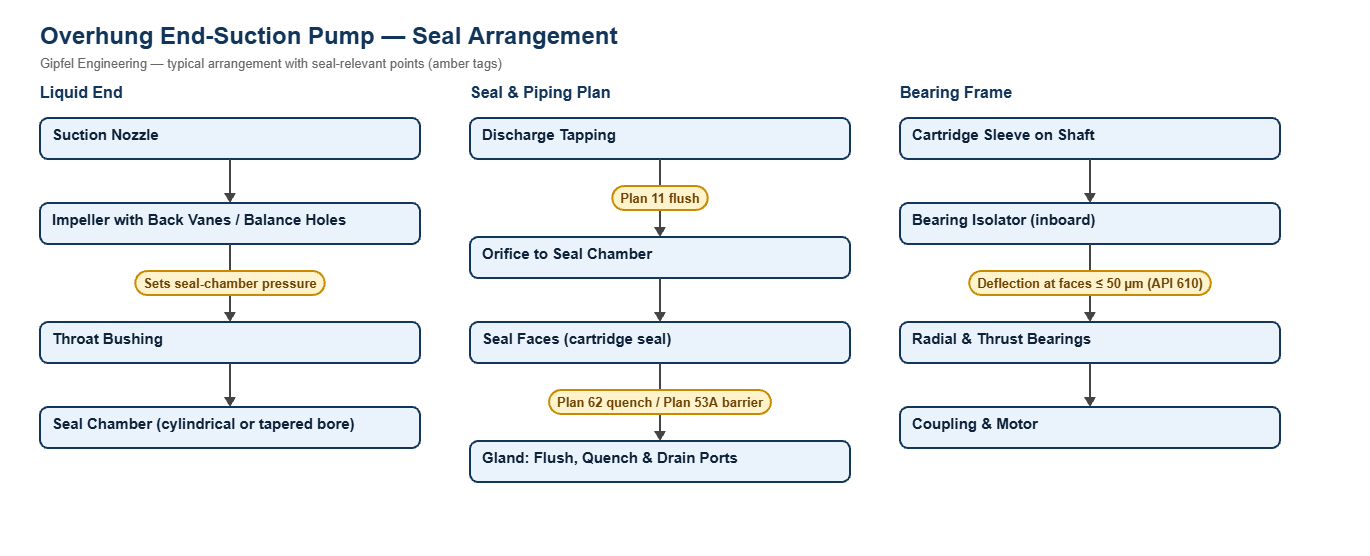
Overhung pumps carry the impeller on the end of a shaft that projects beyond the bearings. They are the most common process pump: ISO 2858 / ISO 5199 chemical pumps, EN 733 water pumps, ANSI B73.1 pumps and API 610 OH1, OH2 and OH3 pumps. Because the impeller is cantilevered, shaft deflection at the seal faces rises sharply when the pump runs away from its best efficiency point, and that deflection, not the fluid alone, is a leading cause of seal failure on these pumps.
The seal chamber sits directly behind the impeller. Its pressure is set by the impeller back vanes or balance holes and is usually close to suction pressure plus a fraction of the differential head. Size the seal for that seal-chamber pressure, not the discharge pressure, and confirm it from the pump maker or by measurement.
Key Sealing Challenges
- Shaft deflection: API 610 limits deflection at the primary seal faces to 50 µm (0.002 in). ANSI B73.1 pumps use a shaft flexibility index L³/D⁴ below 60 in⁻¹ (about 2.4 mm⁻¹). Running at low flow pushes the shaft beyond these values.
- Seal-chamber geometry: older pumps have narrow packing boxes; modern pumps have large cylindrical or tapered bores. Cartridge seals must match the bore, gland stud pattern and the distance to the first obstruction.
- Vapour and solids: a cylindrical chamber needs a flush to remove heat and vapour; a tapered bore helps solids and vapour leave the faces but should not be combined with a flush that disturbs its flow pattern.
- Packing conversion: many older pumps still run gland packing. A cartridge seal on its own sleeve removes shaft-sleeve wear and leakage.
Which mechanical seal suits an overhung end-suction pump?
Most overhung chemical and process pumps use a balanced cartridge seal sized for seal-chamber pressure, with API Plan 11 flush on clean fluids. Toxic or volatile fluids need a pressurised double seal on Plan 53A, hot oil above about 260 °C a metal bellows seal with steam quench, and abrasive fluids a slurry cartridge on Plan 32.
Fault Diagnosis Example
Symptom: Seal on an end-suction chemical pump leaks within weeks; wear track on the stationary face is wide and off-centre.
  ├── Incorrect Response: "Fit a harder face material."
  ├── Diagnostic Evidence Required:
  │     ├── Where does the pump run on its curve? Long periods at low flow raise radial load and shaft deflection.
  │     ├── Measure shaft runout and end play at the seal chamber with a dial gauge.
  │     └── Check bearing condition and pipe strain on the casing.
  └── Engineered Solution:
        ├── Return the pump to its operating range (minimum-flow bypass or a trimmed impeller).
        ├── Correct runout, bearings and pipe strain before refitting.
        └── Fit a balanced cartridge seal with its own sleeve, set to the pump maker's dimensions.
Frequently Asked Questions
Can a packed overhung pump be converted to a mechanical seal without machining?
Usually yes. A cartridge seal is designed to the existing stuffing-box bore, depth and gland studs. Where the bore is too narrow for a cartridge, a component seal or a pump-specific design is used. Send the stuffing-box dimensions or the pump make and model.
Why does seal life drop when the pump runs at low flow?
Away from its best efficiency point the impeller sees an uneven radial load, which bends the cantilevered shaft. The faces then open and close every revolution, which causes leakage and face damage. The remedy is to restore the operating point, not only to change the seal.
When is a double seal needed on an end-suction pump?
When a leak would be toxic, flammable or environmentally unacceptable, or when the fluid cannot lubricate the faces. A pressurised double seal on Plan 53A keeps clean barrier fluid between the faces; an unpressurised tandem seal on Plan 52 suits flashing hydrocarbons.
Related: Between-Bearings Split-Case Pumps · Multistage & Boiler Feed Pumps · Chemical Plants · All process pump solutions.
Request a Seal Selection
Send your pump make and model, fluid, temperature, pressure, shaft size and speed to info@gipfelengg.com or use our enquiry form. Gipfel Engineering (ISO 9001:2015, NSIC-registered MSME, Mumbai) designs and manufactures mechanical seals, seal support systems and process pumps.
Overhung Pump Duty & Mechanical Seal Selection Matrix
Typical values for selection guidance only. Final selection is made against the pump data sheet and seal-chamber dimensions.
| Pump type / duty | Typical makes & models | Typical conditions | Seal arrangement | Faces / elastomer | API piping plan |
|---|---|---|---|---|---|
| ISO 2858 / ISO 5199 chemical process pump | KSB CPK, MCPK, Mega-Chem; Sulzer CZ; Flowserve CPX | Clean chemicals and solvents; ambient–150 °C; seal-chamber pressure to the pump datasheet | Balanced multi-spring cartridge seal | SiC vs carbon (clean) or SiC vs SiC (corrosive / crystallising); FKM, EPDM or FFKM to suit the fluid | Plan 11; add Plan 62 quench where product crystallises or oxidises |
| EN 733 / general-service end-suction pump | KSB Etanorm; Grundfos NK, NB; Lowara e-SH; Ebara 3M / 3P | Water, condensate and light chemicals; low seal-chamber pressure | Single-spring component seal or Wave-spring semi-cartridge seal | Carbon vs SiC; EPDM (water) or FKM (oils, light chemicals) | Plan 11 or dead-ended (Plan 02) on clean cool water |
| Close-coupled vertical in-line pump | KSB Etaline; Grundfos TP | HVAC, cooling and transfer water; seal at top of the pump, vapour can collect | Wave-spring semi-cartridge seal or Balanced multi-spring cartridge seal | Carbon vs SiC; EPDM | Plan 11 with the chamber vented before start-up |
| API 610 OH2 refinery / petrochemical pump | Sulzer ZE; Akay OH2 | Hydrocarbons, light ends and toxic fluids; seal-chamber pressure to the pump datasheet | Double cartridge seal, back-to-back (pressurised) or Tandem double cartridge seal (unpressurised) | SiC vs carbon inboard; FKM or FFKM (FFKM where amines or aromatics are present) | Plan 53A (barrier ≥ 1.4 bar above seal chamber) for toxic fluids; Plan 52 for flashing hydrocarbons |
| Hot oil / thermic-fluid circulation | End-suction hot-oil pumps (make and model to confirm) | Thermal oil above about 260 °C, beyond the limits of most elastomers | Stationary metal bellows cartridge seal | SiC vs carbon; flexible graphite secondary seals | Plan 62 steam or nitrogen quench to stop coking on the atmospheric side |
| Recessed-impeller / solids-handling end-suction | Vortex and recessed-impeller ranges (make and model to confirm) | Light slurries and fibrous liquids; tapered-bore chamber preferred | Slurry cartridge seal, external springs (catalogue ref. HS860) | SiC vs SiC; EPDM or FKM | Plan 32 clean flush ≈ 1 bar above seal chamber, or tapered bore without flush. No Plan 11 on abrasive or fibrous fluids |
| Non-metallic (PP / PVDF) acid pump | Polypropylene and PVDF acid pumps (e.g. Antico, Rajedia) | Hydrochloric and other mineral acids at modest temperature | Externally mounted seal with non-metallic wetted parts (on request) | SiC or alumina ceramic vs PTFE-based faces (on hydrofluoric acid use SiC, never ceramic or glass-filled grades); PTFE / FFKM | Plan 62 where acid fumes or crystals form; confirm with acid concentration |
Reviewed by Gipfel Engineering’s technical team.
Technical Information Disclaimer
The information on this page, including process descriptions, flow diagrams, operating ranges, seal arrangements, materials and piping plans, is general technical guidance for information only. Values shown are typical industry ranges, not guaranteed ratings or specifications of any Gipfel Engineering product. Each application differs. Seal selection, material compatibility, installation and operation must be verified by qualified personnel against the specific equipment data sheet, process conditions, applicable codes and the pump manufacturer’s instructions. A binding recommendation is given only in a written quotation or technical offer from Gipfel Engineering.
References to standards (such as API 682, ISO 21049, ISO 3069, FDA 21 CFR 177.2600 and NACE MR0175 / ISO 15156) describe common industry practice. They do not mean that any product is certified, qualified or approved to that standard unless this is confirmed in writing for a specific order. Third-party company and product names, including “equivalent to” references, are used for identification only and remain the trademarks of their owners. No affiliation, endorsement or OEM approval is implied.
Compliance with safety, hazardous-area, environmental and statutory requirements at the user’s site remains the responsibility of the plant owner or operator. To the extent permitted by law, Gipfel Engineering accepts no liability for loss or damage arising from reliance on this general information without a confirmed written recommendation. Content may change without notice.