
Pulp, MC Stock & Refiner Pumps
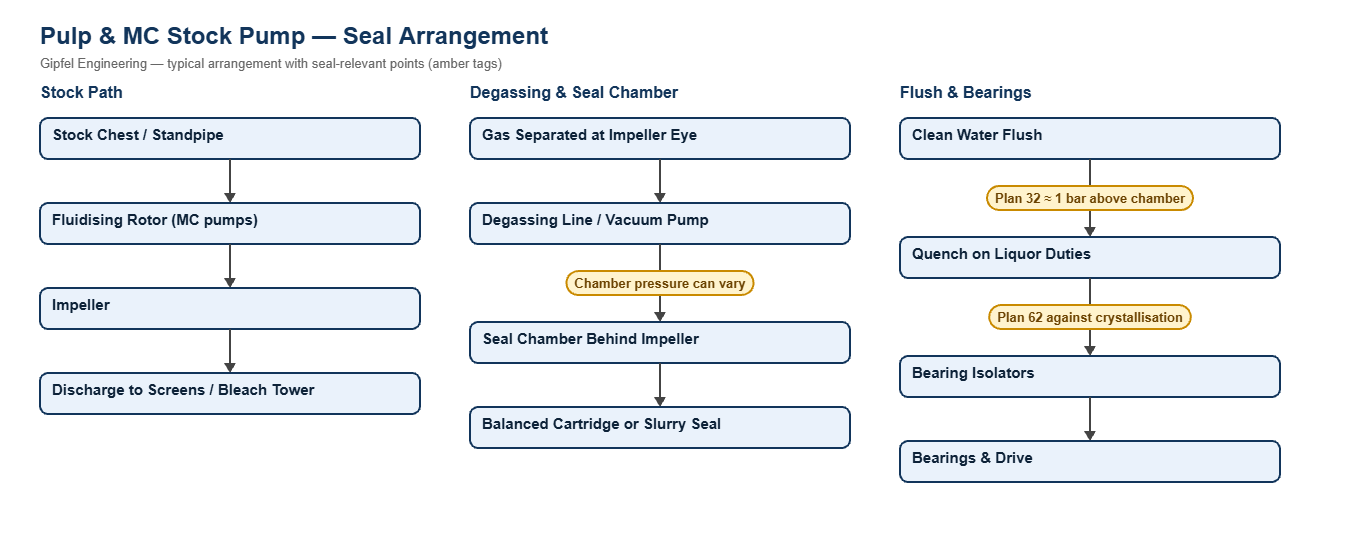
Process Overview
Pulp, MC Stock & Refiner Pumps — Sealing Overview
Pulp and paper mills pump fibre suspensions from a few per cent consistency up to about 15 %. Low-consistency stock and white water move through conventional centrifugal pumps. Medium-consistency (MC) pumps use a fluidising rotor to make thick stock flow and a degassing system to remove the air it carries. Disc refiners, liquor pumps in chemical recovery and paper-machine fan pumps complete the list.
Fibre is the main threat to the seal. Fibres wrap around springs and drive parts, pack between the faces and hold them open. The seal therefore needs springs outside the stock, hard faces, a large-bore chamber and a clean water flush (Plan 32). Plan 11 is never used on stock, because it feeds fibre straight into the seal chamber.
Key Sealing Challenges
- Fibre packing: fibres stop springs from following the faces. Use seals with springs outside the stock and keep the chamber flushed with clean water.
- Degassing on MC pumps: the degassing system changes the pressure around the seal. Confirm the seal-chamber pressure with degassing running before setting the flush pressure.
- Caustic liquors: black, green and white liquors attack the free silicon in reaction-bonded silicon carbide and some carbon grades, and they crystallise on the atmospheric side. Use sintered SiC faces and a Plan 62 quench.
- Water use: mills want to cut fresh-water use. A mechanical seal on Plan 32 uses much less water than gland packing.
Which mechanical seal suits a pulp or MC stock pump?
Use a slurry-type cartridge seal with SiC vs SiC faces and springs outside the stock (Gipfel HS860), with a Plan 32 clean water flush about 1 bar above seal-chamber pressure. Use sintered SiC and a Plan 62 quench on caustic liquors. Never use Plan 11 on fibre.
Fault Diagnosis Example
Symptom: MC pump seal leaks intermittently; faces open up and fibre is found between the springs.
  ├── Incorrect Response: "Fit stronger springs."
  ├── Diagnostic Evidence Required:
  │     ├── Is the flush Plan 11 (from discharge) or Plan 32 (clean water)?
  │     ├── Measure seal-chamber pressure with the degassing system running; is the flush pressure above it?
  │     └── Are the springs in contact with stock?
  └── Engineered Solution:
        ├── Replace Plan 11 with a Plan 32 clean water flush about 1 bar above chamber pressure.
        ├── Use a cartridge seal with springs outside the stock.
        └── Interlock the flush with the pump start.
Frequently Asked Questions
Why is Plan 11 not used on stock pumps?
Plan 11 takes the flush from pump discharge, so it carries fibre into the seal chamber. On stock it packs fibre around the faces. A clean external flush (Plan 32) keeps fibre out.
Which face materials suit black liquor?
Sintered silicon carbide on both faces. Black, green and white liquors are caustic: they attack the free silicon in reaction-bonded silicon carbide and some carbon grades, and their crystals abrade carbon faces. Pair the seal with a Plan 62 quench to stop crystals forming on the atmospheric side.
Can a split seal be used on a disc refiner?
On suitable duties, yes. A split seal can be fitted without opening the refiner, which shortens downtime. The duty pressure, speed and stock consistency decide whether it is suitable.
Related: Pulp Mill & Chemical Recovery · Paper Machine & Stock Prep · Slurry Pumps · All process pump solutions.
Request a Seal Selection
Send your pump make and model, stock consistency, temperature, pressure, shaft size and speed to info@gipfelengg.com or use our enquiry form. Gipfel Engineering (ISO 9001:2015, NSIC-registered MSME, Mumbai) designs and manufactures mechanical seals, seal support systems and process pumps.
Pulp & Stock Pump Duty & Mechanical Seal Selection Matrix
Typical values for selection guidance only. Final selection is made against the pump data sheet, stock consistency and seal-chamber dimensions.
| Pump type / duty | Typical makes & models | Typical conditions | Seal arrangement | Faces / elastomer | API piping plan |
|---|---|---|---|---|---|
| Low-consistency stock pump (below about 6 % consistency) | End-suction stock pumps (model to confirm) | Fibre suspension with fillers and sand; low seal-chamber pressure | Slurry cartridge seal, external springs (catalogue ref. HS860) or Balanced multi-spring cartridge seal | SiC vs SiC; EPDM | Plan 32 clean water ≈ 1 bar above chamber. No Plan 11 on fibre |
| Medium-consistency (MC) pump with fluidising rotor and degassing | Sulzer MC and similar MC pumps | Stock at about 8–15 % consistency; gas removed through the degassing line; chamber pressure varies with the degassing system | Slurry cartridge seal, external springs (catalogue ref. HS860) | SiC vs SiC; EPDM | Plan 32 so the faces are never dry; confirm chamber pressure with the degassing system running |
| Black, green and white liquor pumps (chemical recovery) | Liquor circulation and transfer pumps (model to confirm) | Hot caustic liquors that crystallise on the atmospheric side | Slurry cartridge seal, external springs (catalogue ref. HS860) | Sintered SiC vs sintered SiC only (caustic); EPDM | Plan 62 water quench against crystallisation; Plan 32 where dilution is allowed |
| Paper machine white-water and fan pumps | Large fan and white-water pumps (model to confirm) | Large flows of fibre- and filler-laden water; often double-suction pumps | Balanced multi-spring cartridge seal | SiC vs SiC; EPDM | Plan 32; see the between-bearings page for split-case fan pumps |
| Disc refiners | Disc refiners (model to confirm) | Seal change is costly because the refiner must be opened | Split mechanical seal (on suitable duties) | Carbon or SiC vs SiC; EPDM | Plan 32 clean water flush |
Reviewed by Gipfel Engineering’s technical team.
Technical Information Disclaimer
The information on this page, including process descriptions, flow diagrams, operating ranges, seal arrangements, materials and piping plans, is general technical guidance for information only. Values shown are typical industry ranges, not guaranteed ratings or specifications of any Gipfel Engineering product. Each application differs. Seal selection, material compatibility, installation and operation must be verified by qualified personnel against the specific equipment data sheet, process conditions, applicable codes and the pump manufacturer’s instructions. A binding recommendation is given only in a written quotation or technical offer from Gipfel Engineering.
References to standards (such as API 682, ISO 21049, ISO 3069, FDA 21 CFR 177.2600 and NACE MR0175 / ISO 15156) describe common industry practice. They do not mean that any product is certified, qualified or approved to that standard unless this is confirmed in writing for a specific order. Third-party company and product names, including “equivalent to” references, are used for identification only and remain the trademarks of their owners. No affiliation, endorsement or OEM approval is implied.
Compliance with safety, hazardous-area, environmental and statutory requirements at the user’s site remains the responsibility of the plant owner or operator. To the extent permitted by law, Gipfel Engineering accepts no liability for loss or damage arising from reliance on this general information without a confirmed written recommendation. Content may change without notice.