
Pulp Mill & Chemical Recovery
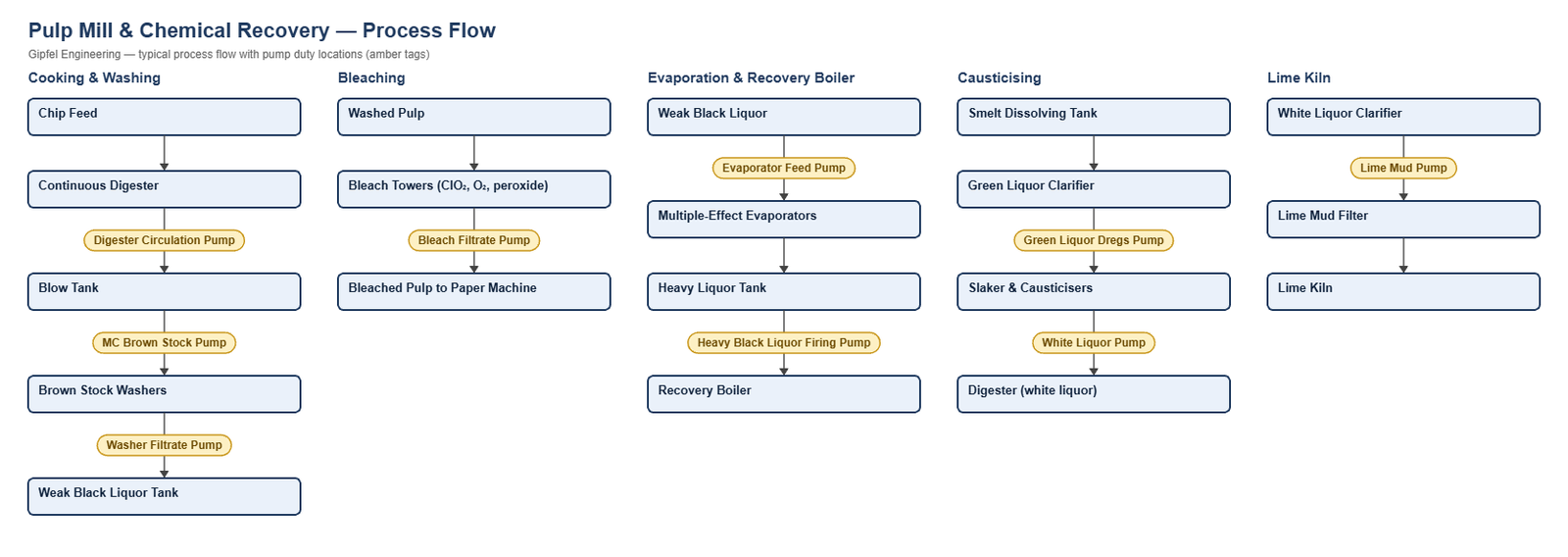
Process Overview
Pulp Mill & Chemical Recovery — Process Overview
In a kraft pulp mill, wood chips are cooked in white liquor (sodium hydroxide and sodium sulphide) in a continuous or batch digester. The pulp is washed in brown stock washers, oxygen-delignified and bleached with chlorine dioxide, oxygen and peroxide. The spent black liquor is concentrated in multiple-effect evaporators and burned in the recovery boiler; the smelt is dissolved to green liquor, clarified and causticised with lime to regenerate white liquor, and the lime mud is reburned in the lime kiln.
For stock preparation and the paper machine see Paper Machine & Stock Preparation.
Key Sealing Challenges
- Fibre: pulp and filtrates carry fibre that clogs springs and Plan 11 orifices; slurry cartridges with external springs and a clean flush are used.
- Hot alkali: white, green and black liquor attack the free silicon in reaction-bonded SiC; sintered SiC is specified.
- Bleach chemicals: acidic chlorine dioxide filtrates need titanium metal parts and FKM or FFKM.
- Crystallising liquor: heavy black liquor solidifies on the atmospheric side unless a barrier or quench is fitted.
What mechanical seal is used on black liquor pumps?
Black liquor pumps typically use a cartridge seal with sintered silicon carbide vs. sintered silicon carbide faces and duplex metal parts. Weak liquor uses a condensate flush (Plan 32) with a Plan 62 quench; heavy liquor firing pumps use a double seal on a pressurised barrier (Plan 53A) or a condensate flush with steam quench, because the liquor solidifies when it cools.
Root-Cause Failure Analysis — Field Example
Symptom: Heavy black liquor firing pump seal will not turn after a short stop; faces and springs encased in hard liquor.
  ├── Incorrect Response: "Fit harder faces."
  ├── Diagnostic Evidence Required:
  │     ├── Has black liquor solidified on the atmospheric side and around the springs?
  │     ├── Was a quench or barrier fitted and in service during the stop?
  │     └── Check face material: reaction-bonded SiC leached by hot alkali?
  └── Engineered Solution:
        ├── Double seal with Plan 53A barrier, or Plan 32 condensate flush with Plan 62 steam quench.
        ├── Keep the quench or barrier in service during stops.
        └── Sintered SiC vs sintered SiC faces with duplex metal parts.
Frequently Asked Questions
Why is API Plan 11 avoided on pulp stock pumps?
Plan 11 takes flush liquid from pump discharge. On stock and fibrous filtrates the fibres plug the orifice and pack the seal chamber. A Plan 32 clean water flush or a seal designed for dead-ended slurry service is used instead.
Which metal suits bleach plant filtrates?
Chlorine dioxide filtrates are acidic and rich in chlorides, which attack stainless steel. Titanium metal parts are used.
Related: Paper Machine & Stock Preparation · General Chemical Plants · Co-Generation & Biomass.
Request a Seal Selection
Send your pump make and model, fluid, temperature, pressure, shaft size and speed to info@gipfelengg.com or use our enquiry form. Gipfel Engineering (ISO 9001:2015, NSIC-registered MSME, Mumbai) designs and manufactures mechanical seals, seal support systems and process pumps.
Equipment solutions: Pulp & MC Stock Pumps · Slurry Pumps · Agitators.
Pump Duty & Mechanical Seal Selection Matrix
Typical values for selection guidance only. Final selection is made against the customer duty sheet.
| Pump duty | Fluid | Typical temp. | Typical pressure (bar) | Seal arrangement | Faces / elastomer | API piping plan |
|---|---|---|---|---|---|---|
| Continuous Digester Circulation Pump | Cooking liquor with chip fines | 150–170 °C | 10–15 bar | Double cartridge, back-to-back (pressurised) with duplex metal parts | Sintered SiC vs sintered SiC / FFKM (or peroxide-cured EPDM below 150 °C) | API Plan 53A (barrier ≥ 1.4 bar above seal chamber) |
| Medium-Consistency Brown Stock Pump | Pulp at 8–12 % consistency | 60–90 °C | 3–8 bar | Slurry cartridge, external springs (catalogue ref. HS860) | Sintered SiC vs sintered SiC / EPDM | API Plan 32 (clean water flush) — no Plan 11 on fibrous stock |
| Brown Stock Washer Filtrate Pump | Weak black liquor with fibre and foam | 70–90 °C | 2–5 bar | Slurry cartridge, external springs (catalogue ref. HS860) | Sintered SiC vs sintered SiC / EPDM | API Plan 32 or Plan 62 quench |
| Bleach Plant Filtrate / Stock Pump | Acidic filtrate with chlorine dioxide and chlorides | 60–80 °C | 2–5 bar | Slurry cartridge, external springs (catalogue ref. HS860) with titanium metal parts | SiC vs SiC / FKM or FFKM | API Plan 32 |
| Weak Black Liquor / Evaporator Feed Pump | Black liquor, 15–20 % solids | 80–110 °C | 3–6 bar | Balanced multi-spring cartridge with duplex metal parts | Sintered SiC vs sintered SiC / EPDM | API Plan 32 (condensate flush) + Plan 62 quench |
| Heavy Black Liquor Firing Pump | Black liquor, 65–80 % solids, viscous | 115–130 °C | 4–10 bar | Double cartridge, back-to-back (pressurised) with duplex metal parts | Sintered SiC vs sintered SiC / FFKM or EPDM | API Plan 53A (barrier ≥ 1.4 bar above seal chamber), or Plan 32 condensate flush + Plan 62 steam quench |
| Green Liquor Dregs Pump | Green liquor with abrasive dregs | 85–95 °C | 2–5 bar | Slurry cartridge, external springs (catalogue ref. HS860) | Sintered SiC vs sintered SiC / EPDM | API Plan 32 |
| White Liquor Pump | Clarified white liquor (NaOH + Na₂S) | 85–95 °C | 3–8 bar | Balanced multi-spring cartridge | Sintered SiC vs sintered SiC / EPDM | API Plan 11 + Plan 62 water quench |
| Lime Mud Pump | Lime mud slurry, abrasive | 70–90 °C | 2–5 bar | Slurry cartridge, external springs (catalogue ref. HS860) | Sintered SiC vs sintered SiC (or tungsten carbide pair) / EPDM | API Plan 32 |
Reviewed by Gipfel Engineering’s technical team.
Technical Information Disclaimer
The information on this page, including process descriptions, flow diagrams, operating ranges, seal arrangements, materials and piping plans, is general technical guidance for information only. Values shown are typical industry ranges, not guaranteed ratings or specifications of any Gipfel Engineering product. Each application differs. Seal selection, material compatibility, installation and operation must be verified by qualified personnel against the specific equipment data sheet, process conditions, applicable codes and the pump manufacturer’s instructions. A binding recommendation is given only in a written quotation or technical offer from Gipfel Engineering.
References to standards (such as API 682, ISO 21049, ISO 3069, FDA 21 CFR 177.2600 and NACE MR0175 / ISO 15156) describe common industry practice. They do not mean that any product is certified, qualified or approved to that standard unless this is confirmed in writing for a specific order. Third-party company and product names, including “equivalent to” references, are used for identification only and remain the trademarks of their owners. No affiliation, endorsement or OEM approval is implied.
Compliance with safety, hazardous-area, environmental and statutory requirements at the user’s site remains the responsibility of the plant owner or operator. To the extent permitted by law, Gipfel Engineering accepts no liability for loss or damage arising from reliance on this general information without a confirmed written recommendation. Content may change without notice.