
Cement & Construction
Process Overview
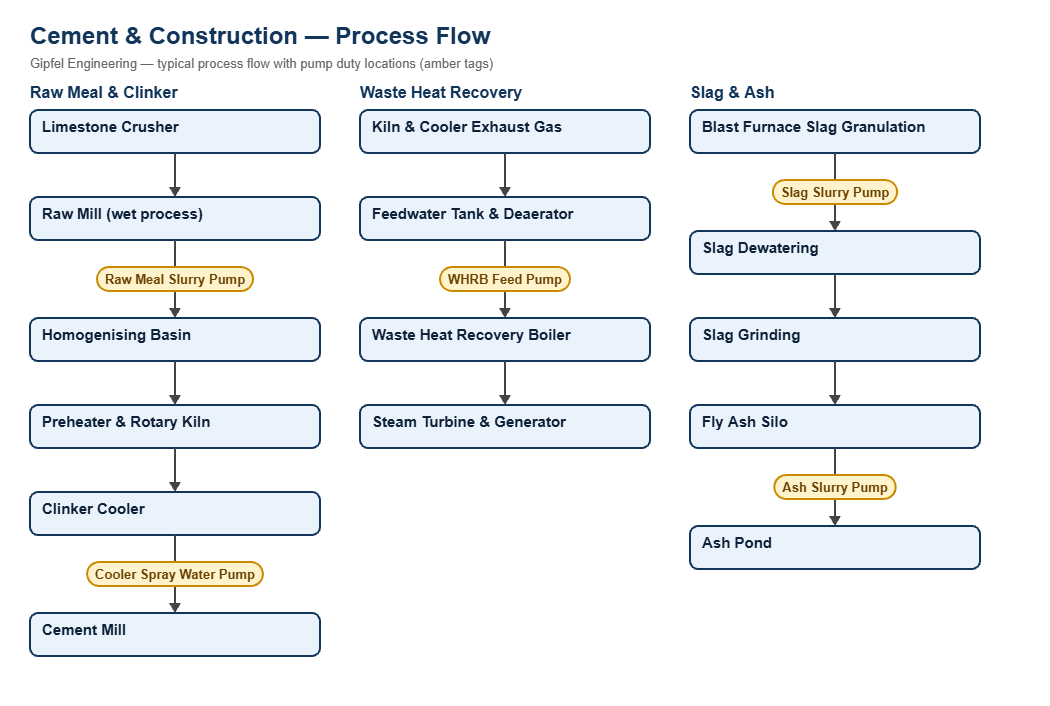
Cement & Construction — Process Overview
Cement, lime and aggregate plants expose pumps to abrasive limestone and slag slurries, fly ash, alkaline recycled water and, in waste heat recovery power plants, hot high-pressure boiler feedwater. Airborne dust adds wear on bearings and seal hardware.
Primary Process Sections Covered:
- Raw meal preparation: crushing, wet raw milling and slurry homogenising.
- Pyroprocessing: preheater, rotary kiln and clinker cooler water sprays.
- Slag & ash handling: granulated blast furnace slag dewatering and fly ash disposal.
- Waste heat recovery (WHRB): boiler feed and condensate circuits.
What mechanical seal is used on cement plant slurry pumps?
Raw meal, slag and fly ash slurry pumps are typically fitted with heavy-duty slurry cartridge seals with tungsten carbide hard faces, springs kept out of the slurry and FKM or Aflas elastomers, on a clean water flush (API Plan 32) that keeps particles out of the seal chamber.
Engineering Notes
- Slag: granulated slag is sharp and glassy; tungsten carbide vs. tungsten carbide faces resist chipping and wear.
- WHRB feed pumps: hot feedwater needs API Plan 23 cooling; the seal is sized for seal-chamber pressure, not pump discharge.
- Dust: keep bearing housings sealed against dust ingress to protect pump bearings and seal alignment.
Root-Cause Failure Analysis — Field Example
Symptom: Slag slurry pump seal leaks within weeks; faces chipped at the edges.
  ├── Diagnostic Evidence Required:
  │     ├── Are face edges chipped by sharp slag particles entering the seal gap?
  │     ├── Is flush water dirty or below seal-chamber pressure?
  │     ├── Is shaft deflection high from worn bearings?
  └── Engineered Solution:
        ├── Fit a heavy slurry cartridge with tungsten carbide vs tungsten carbide faces.
        ├── Supply clean flush water about 1 bar (15 psi) above seal-chamber pressure.
        ├── Replace worn bearings and check impeller clearance.
Operational & Environmental Benefits
- Less flush water: slurry cartridge seals use less water than flushed gland packing, reducing slurry dilution.
- Cleaner plant areas: reduced leakage of abrasive slurry around pumps.
Frequently Asked Questions
Which faces suit slag and fly ash slurry pumps?
Hard face pairs such as tungsten carbide vs. tungsten carbide or tungsten carbide vs. silicon carbide resist abrasive ash and slag particles; carbon faces wear rapidly in these duties.
Why do WHRB feed pump seals use Plan 23?
Hot boiler feedwater has little lubricity and flashes easily. Plan 23 circulates seal-chamber water through a cooler with a pumping ring, keeping the faces below their temperature limit.
Request a Seal Selection
Send your pump make and model, fluid, solids, temperature, pressure, shaft size and speed to info@gipfelengg.com or use our enquiry form. Related: mining & minerals, power generation. Gipfel Engineering (ISO 9001:2015, NSIC-registered MSME, Mumbai) designs and manufactures mechanical seals, seal support systems and process pumps.
Equipment solutions: Slurry Pumps · Blowers · Mills.
Pump Duty & Mechanical Seal Selection Matrix
Typical values for selection guidance only. Final selection is made against the customer duty sheet.
| Pump duty | Fluid | Typical temp. | Typical pressure (bar) | Seal arrangement | Faces / elastomer | API piping plan |
|---|---|---|---|---|---|---|
| Raw Meal Slurry Transfer (wet process) | Limestone slurry, 35–45% solids | Ambient–45°C | 4.0–7.5 | Heavy-duty slurry single cartridge, springs out of the product (catalogue ref. HS860) | Tungsten carbide vs SiC / FKM | API Plan 32 (clean water flush) |
| Clinker Cooler Spray Water | Recycled water with clinker fines, pH 9–11 | 40–60°C | 8–15 | Wave spring heavy-duty cartridge | SiC vs SiC / EPDM | API Plan 11 with throttle bushing |
| Granulated Slag (GBFS) Slurry | Quenched slag, 40–55% solids, sharp glassy particles | 45–65°C | 5–9 | Heavy slurry cartridge (catalogue ref. HS860) | Tungsten carbide vs tungsten carbide / Aflas | API Plan 32 |
| WHRB Boiler Feed | Deaerated boiler feedwater | 120–150°C | 40–90 discharge (seal sees suction / balance-line pressure — verify per pump) | High-pressure seal, stationary springs (catalogue ref. HP760) | SiC vs carbon / Aflas | API Plan 23 (pumping ring + cooler) |
| Fly Ash Slurry Disposal | Fly ash slurry, 25–40% solids | Ambient–50°C | 4.5–8.0 | Heavy slurry single cartridge (catalogue ref. HS860) | Tungsten carbide vs SiC / FKM | API Plan 32 |
Reviewed by Gipfel Engineering’s technical team.
Technical Information Disclaimer
The information on this page, including process descriptions, flow diagrams, operating ranges, seal arrangements, materials and piping plans, is general technical guidance for information only. Values shown are typical industry ranges, not guaranteed ratings or specifications of any Gipfel Engineering product. Each application differs. Seal selection, material compatibility, installation and operation must be verified by qualified personnel against the specific equipment data sheet, process conditions, applicable codes and the pump manufacturer’s instructions. A binding recommendation is given only in a written quotation or technical offer from Gipfel Engineering.
References to standards (such as API 682, ISO 21049, ISO 3069, FDA 21 CFR 177.2600 and NACE MR0175 / ISO 15156) describe common industry practice. They do not mean that any product is certified, qualified or approved to that standard unless this is confirmed in writing for a specific order. Third-party company and product names, including “equivalent to” references, are used for identification only and remain the trademarks of their owners. No affiliation, endorsement or OEM approval is implied.
Compliance with safety, hazardous-area, environmental and statutory requirements at the user’s site remains the responsibility of the plant owner or operator. To the extent permitted by law, Gipfel Engineering accepts no liability for loss or damage arising from reliance on this general information without a confirmed written recommendation. Content may change without notice.