
Marine & Shipbuilding
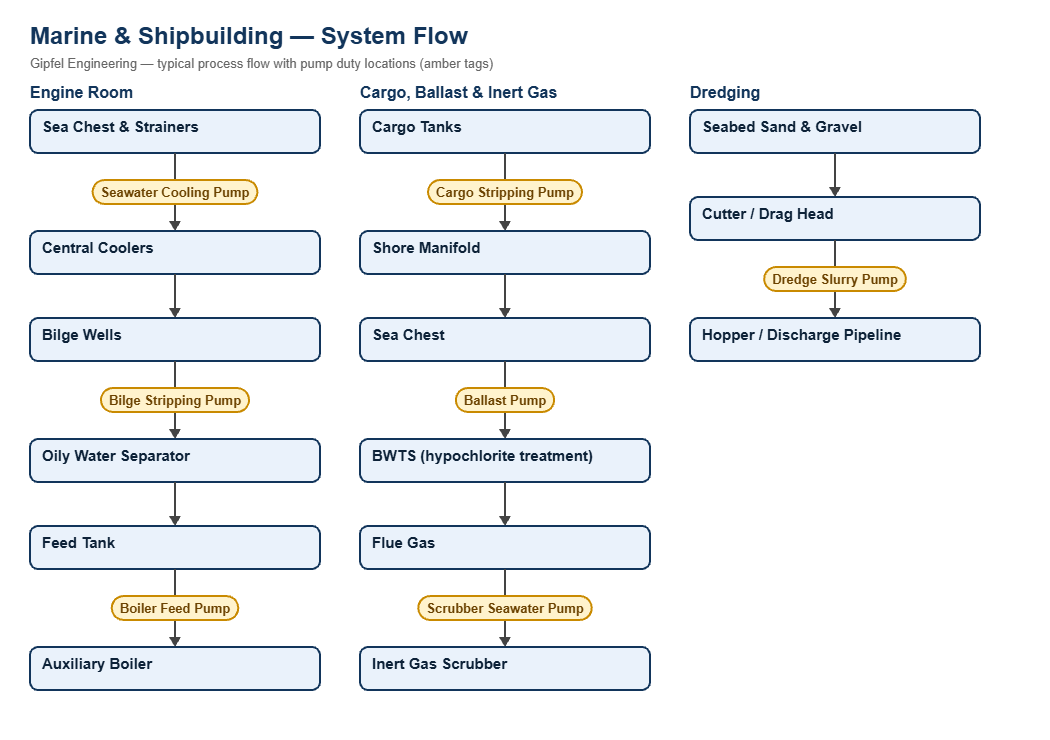
System Overview
Marine & Shipbuilding — System Overview
Ships, offshore support vessels and dredgers run pumps on seawater, hypochlorite-treated ballast water, oily bilge water, cargo hydrocarbons, boiler feedwater and abrasive dredge slurry, under constant vibration and with limited space for maintenance. Seawater corrosion and galvanic attack drive material selection.
Primary Systems Covered:
- Engine room: seawater cooling, bilge and auxiliary boiler feed.
- Cargo & ballast: cargo oil stripping, ballast water treatment and inert gas scrubbing.
- Dredging: cutter suction and trailing hopper dredge pumps.
What mechanical seal suits ship seawater pumps?
Seawater cooling pumps are typically fitted with balanced cartridge seals with silicon carbide vs. silicon carbide faces, which resist silt, and super duplex 2507 or nickel-aluminium bronze wetted parts, which resist seawater corrosion and galvanic attack. A cyclone separator flush (API Plan 31) removes sand from the seal flush.
Root-Cause Failure Analysis — Field Example
Symptom: Bilge pump seal fails after repeated stripping operations.
  ├── Diagnostic Evidence Required:
  │     ├── Are the faces heat-checked or blistered (dry running at loss of suction)?
  │     ├── Are sand and oil residues packed around the seal?
  │     ├── Is the seal single, with nothing to lubricate it when the pump runs dry?
  └── Engineered Solution:
        ├── Fit a dual cartridge seal on Plan 53A with a fresh-water barrier.
        ├── Keep barrier pressure ≥ 1.4 bar above seal-chamber pressure.
        ├── Add a low-level or dry-run trip on the pump.
Frequently Asked Questions
Which materials resist seawater in pump seals?
Super duplex 2507 (PREN about 42), titanium and nickel-aluminium bronze resist seawater pitting and crevice corrosion far better than 316L. Silicon carbide faces resist abrasive silt. Materials must also be chosen to avoid galvanic corrosion with the pump casing.
Why do ballast water treatment pumps need special materials?
Electro-chlorination and hypochlorite dosing make ballast water strongly oxidising. Titanium or super duplex hardware and FFKM or FKM elastomers resist this attack.
Request a Seal Selection
Send your pump make and model, fluid, temperature, pressure, shaft size, speed and class requirements to info@gipfelengg.com or use our enquiry form. Related: oil & gas, water & desalination. Gipfel Engineering (ISO 9001:2015, NSIC-registered MSME, Mumbai) designs and manufactures mechanical seals, seal support systems and process pumps.
Equipment solutions: Split-Case Pumps · Overhung Pumps.
Pump Duty & Mechanical Seal Selection Matrix
Typical values for selection guidance only. Final selection is made against the pump data sheet and class / owner specification.
| Pump duty | Fluid | Typical temp. | Typical pressure (bar) | Seal arrangement | Faces / elastomer | API piping plan |
|---|---|---|---|---|---|---|
| Main Seawater Cooling | Seawater, 35,000 ppm TDS, silt | Ambient–35°C | 3.5–5.5 | Balanced cartridge, super duplex 2507 or nickel-aluminium bronze wetted parts | SiC vs SiC / FKM or EPDM | API Plan 31 (cyclone separator) or Plan 11 |
| Ballast Water Treatment (BWTS) | Seawater with sodium hypochlorite | Ambient | 4.0–6.5 | Single chemical-duty cartridge, titanium Gr. 2 or super duplex wetted parts | SiC vs SiC / FFKM or FKM | API Plan 11 |
| Bilge Stripping & Drainage | Oily bilge water with sand; intermittent suction loss | Ambient–45°C | −0.7 to +4.0 | Dual cartridge (dry-run protection) | SiC vs carbon / FKM | API Plan 53A (fresh-water barrier ≥ 1.4 bar above seal-chamber pressure) |
| Cargo Oil Stripping / Booster | Crude oil or refined products | 35–65°C | 8–16 | Dual cartridge | Carbon vs SiC / FKM | API Plan 53A, or Plan 52 vented to slop tank |
| Auxiliary Boiler Feed | Hot deaerated feedwater | 105–130°C | 16–35 | High-pressure seal, stationary springs (catalogue ref. HP760) | SiC vs carbon / Aflas | API Plan 23 (pumping ring + cooler) |
| Dredge Slurry Pump | Seabed sand, gravel and shells, 45–60% solids | Ambient | 6–14 | Heavy-duty slurry cartridge, springs out of the slurry (catalogue ref. HS860) | Tungsten carbide vs tungsten carbide / Aflas | API Plan 32 (clean water above seal-chamber pressure) |
| Inert Gas Scrubber Seawater | Acidic seawater with SO2 and soot, pH 2.5–3.5 | 40–60°C | 3.5–5.0 | Single chemical-duty cartridge, Hastelloy C wetted parts | SiC vs SiC / FFKM or FKM | API Plan 11 or Plan 32 |
Reviewed by Gipfel Engineering’s technical team.
Technical Information Disclaimer
The information on this page, including process descriptions, flow diagrams, operating ranges, seal arrangements, materials and piping plans, is general technical guidance for information only. Values shown are typical industry ranges, not guaranteed ratings or specifications of any Gipfel Engineering product. Each application differs. Seal selection, material compatibility, installation and operation must be verified by qualified personnel against the specific equipment data sheet, process conditions, applicable codes and the pump manufacturer’s instructions. A binding recommendation is given only in a written quotation or technical offer from Gipfel Engineering.
References to standards (such as API 682, ISO 21049, ISO 3069, FDA 21 CFR 177.2600 and NACE MR0175 / ISO 15156) describe common industry practice. They do not mean that any product is certified, qualified or approved to that standard unless this is confirmed in writing for a specific order. Third-party company and product names, including “equivalent to” references, are used for identification only and remain the trademarks of their owners. No affiliation, endorsement or OEM approval is implied.
Compliance with safety, hazardous-area, environmental and statutory requirements at the user’s site remains the responsibility of the plant owner or operator. To the extent permitted by law, Gipfel Engineering accepts no liability for loss or damage arising from reliance on this general information without a confirmed written recommendation. Content may change without notice.