
Compressors & Bearing Chambers
Process Overview
Compressors & Bearing Chambers — Sealing Overview
Process gas compressors raise the pressure of hydrocarbons, hydrogen-rich streams, biogas, refrigerants and air in refineries, petrochemical plants, refrigeration systems and gas-processing skids. Dry screw vacuum pumps and booster skids move gas without oil in the process. Every one of these machines, like every pump, motor, gearbox and fan, also has bearing chambers whose oil must stay clean.
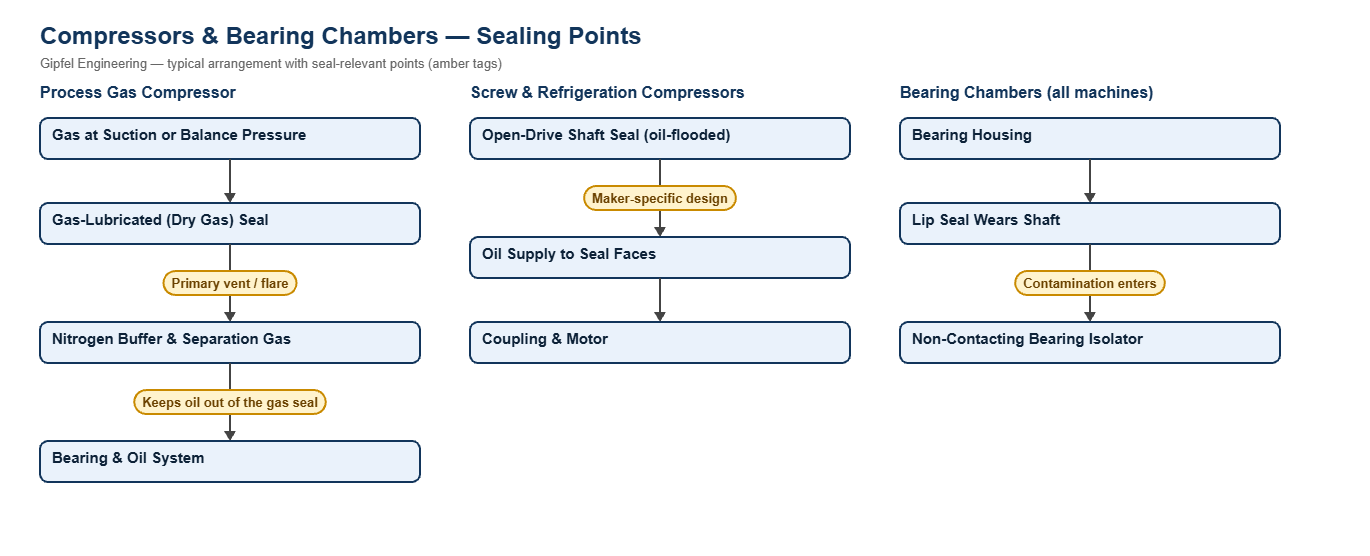
Compressor shaft seals on toxic or flammable gas are gas-lubricated (dry gas) seals: the faces separate on a thin gas film, a filtered seal gas keeps process contaminants away, and nitrogen buffer and separation gas keep bearing oil out of the seal. These systems are designed together with the compressor maker. Refrigeration and screw compressor open-drive seals are oil-flooded designs specific to each compressor. Bearing chambers on all machines gain most from replacing lip seals with non-contacting bearing isolators, which do not wear and keep water and dust out of the oil.
Key Sealing Challenges
- Gas containment: process gas must be kept in, with leakage routed safely to a vent or flare.
- Clean seal gas: liquids or particles in the seal gas damage dry gas seal faces; filtration and conditioning are essential.
- Oil migration: separation gas keeps bearing oil away from the gas seal.
- Bearing contamination: most bearing failures start with water or dust in the oil; bearing isolators stop it.
Which seal suits a process gas compressor?
On toxic or flammable gas, a gas-lubricated (dry gas) seal with filtered seal gas, nitrogen buffer and separation gas, designed with the compressor maker. Refrigeration screw compressors use oil-flooded seals to the compressor’s own design. Bearing chambers on all machines benefit from non-contacting bearing isolators.
Fault Diagnosis Example
Symptom: Dry gas seal on a process compressor shows rising primary vent flow after a plant upset.
  ├── Incorrect Response: "Increase seal gas pressure."
  ├── Diagnostic Evidence Required:
  │     ├── Did liquid or particles reach the seal gas filter during the upset?
  │     ├── Was separation gas available on start-up before lube oil was turned on?
  │     └── Check the seal gas conditioning and filter differential pressure.
  └── Engineered Solution:
        ├── Restore seal gas filtration and conditioning.
        ├── Interlock separation gas ahead of lube oil.
        └── Inspect and refurbish the seal per the maker's procedure.
Frequently Asked Questions
Why do bearing isolators improve reliability?
Lip seals touch the shaft, wear a groove and then let water and dust into the bearing oil. Non-contacting bearing isolators do not wear and keep the oil clean over the machine’s life.
Can Gipfel supply refrigeration compressor shaft seals?
Replacement seals are built to the compressor maker’s design. Send the compressor make, model and the existing seal or drawing.
Related: Industrial Blowers · Industrial Refrigeration · Refinery Treating & Light Ends · All other rotating equipment.
Request a Seal Selection
Send the compressor make and model, gas composition, suction and discharge pressure, shaft size and speed to info@gipfelengg.com or use our enquiry form. Gipfel Engineering (ISO 9001:2015, NSIC-registered MSME, Mumbai) designs and manufactures mechanical seals, seal support systems and process pumps.
Compressor & Bearing Chamber Seal Selection Matrix
Typical values for selection guidance only. Compressor shaft seals are engineered to each compressor maker’s design and operating data.
| Machine / sealing point | Typical equipment | Typical conditions | Seal arrangement | Faces / materials | Gas supply / buffer |
|---|---|---|---|---|---|
| Centrifugal and screw process gas compressor | Process gas, hydrocarbon, hydrogen-rich and biogas compressors | Gas at suction or balance-line pressure; toxic or flammable gas must be contained | Gas-lubricated (dry gas) seal | Gas-lubricated faces to the seal datasheet | Filtered seal gas, nitrogen buffer and separation gas to keep bearing oil out; primary vent to flare or safe location, to the compressor maker’s design |
| Open-drive screw and refrigeration compressor shaft seal | Ammonia and refrigerant screw compressors (make and model to confirm) | Oil-flooded shaft seal; design is specific to each compressor maker | Replacement seal built to the compressor maker’s design (on request) | To the original design; elastomers compatible with the refrigerant (on ammonia typically chloroprene; FKM is attacked by ammonia and EPDM swells in mineral oil) | Oil supply per compressor design |
| Dry screw vacuum pumps and gas boosters | Dry vacuum pumps and booster skids | Process gas at the shaft passage; oil must not reach the process | Gas-lubricated (dry gas) seal or a seal engineered to the machine drawing (on request) | Gas-lubricated or dry-running faces | Nitrogen purge to the machine maker’s design |
| Bearing chambers on pumps, motors, gearboxes, fans and blowers | All rotating equipment with oil- or grease-lubricated bearings | Lip seals wear grooves into shafts and let water, dust and process vapour into the oil | Split bearing isolator | Non-contacting labyrinth design | None required |
Reviewed by Gipfel Engineering’s technical team.
Technical Information Disclaimer
The information on this page, including process descriptions, flow diagrams, operating ranges, seal arrangements, materials and piping plans, is general technical guidance for information only. Values shown are typical industry ranges, not guaranteed ratings or specifications of any Gipfel Engineering product. Each application differs. Seal selection, material compatibility, installation and operation must be verified by qualified personnel against the specific equipment data sheet, process conditions, applicable codes and the pump manufacturer’s instructions. A binding recommendation is given only in a written quotation or technical offer from Gipfel Engineering.
References to standards (such as API 682, ISO 21049, ISO 3069, FDA 21 CFR 177.2600 and NACE MR0175 / ISO 15156) describe common industry practice. They do not mean that any product is certified, qualified or approved to that standard unless this is confirmed in writing for a specific order. Third-party company and product names, including “equivalent to” references, are used for identification only and remain the trademarks of their owners. No affiliation, endorsement or OEM approval is implied.
Compliance with safety, hazardous-area, environmental and statutory requirements at the user’s site remains the responsibility of the plant owner or operator. To the extent permitted by law, Gipfel Engineering accepts no liability for loss or damage arising from reliance on this general information without a confirmed written recommendation. Content may change without notice.