
Industrial Mixers
Process Overview
Industrial Mixers — Sealing Overview
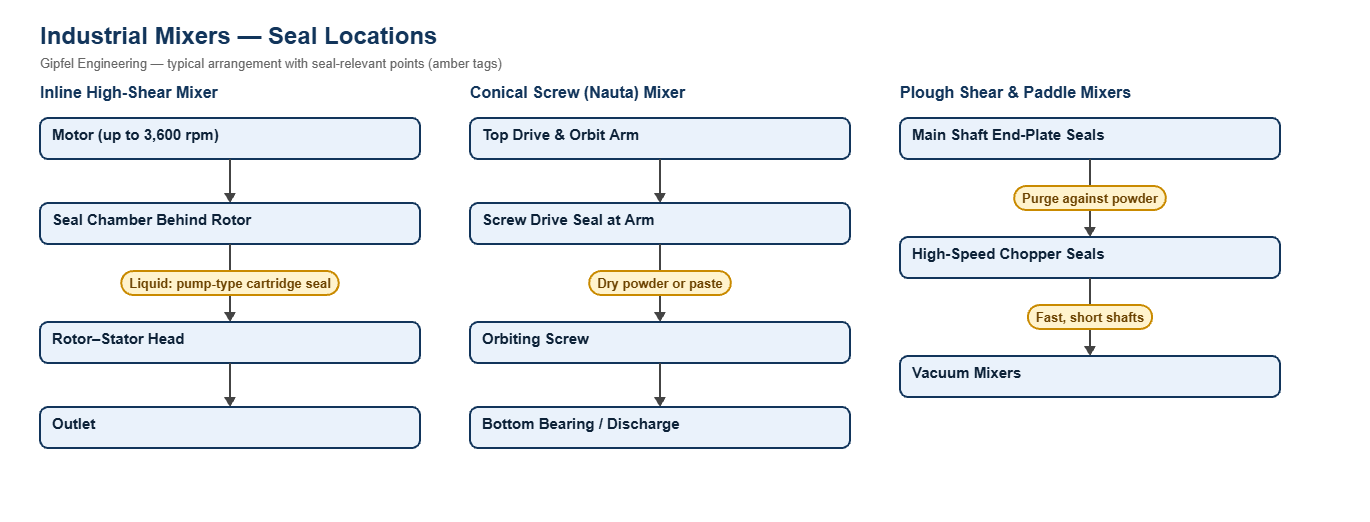
Industrial mixers cover a wide range of machines: inline high-shear rotor–stator mixers for emulsions and dispersions, conical screw (Nauta-type) mixers for powders and pastes, plough shear, double-shaft paddle and contra-rotating mixers with high-speed choppers, vacuum, planetary and double-movement mixers for creams and pastes, and pilot-plant and laboratory mixers.
The seal follows the state of the product. An inline high-shear mixer is sealed like a centrifugal pump: liquid fills the seal chamber behind the rotor, so a balanced cartridge seal works, with a double seal where the product is hazardous or crystallises. Powder mixers are sealed like blenders: the seal runs dry and is protected by an air or nitrogen purge. Vacuum mixers need double seals that hold vacuum, with a liquid or gas barrier depending on whether a barrier leak would harm the product.
Key Sealing Challenges
- Speed range: from a few rpm on conical screw mixers to about 3,600 rpm on inline mixers and choppers; one seal type does not fit all.
- Powders: fine powder works into faces and secondary seals; a purge keeps it out.
- Vacuum: a double seal stops air entering and solvent escaping.
- Hygiene: food, cosmetic and pharmaceutical mixers need cleanable seals and FDA-compliant materials.
Which mechanical seal suits an industrial mixer?
An inline high-shear mixer uses a balanced cartridge seal, or a double seal on Plan 53A for hazardous products. Powder mixers use dry-running seals with an air or nitrogen purge. Vacuum mixers use a double seal with a liquid or gas barrier above vessel pressure.
Fault Diagnosis Example
Symptom: Chopper seals on a plough shear mixer fail within weeks; powder is found behind the faces.
  ├── Incorrect Response: "Fit a harder face."
  ├── Diagnostic Evidence Required:
  │     ├── Is there a purge at each chopper seal, and is it on whenever the mixer runs?
  │     ├── Are the chopper seals designed for dry running at chopper speed?
  │     └── Check chopper bearing condition and shaft runout.
  └── Engineered Solution:
        ├── Fit dry-running seals rated for chopper speed.
        ├── Supply filtered air or nitrogen purge to every chopper seal.
        └── Replace worn chopper bearings.
Frequently Asked Questions
Is an inline mixer seal the same as a pump seal?
Very similar. The seal chamber behind the rotor is liquid-filled, so pump-type cartridge seals are used, chosen for the higher shear, the product and the cleaning regime.
Why do powder mixers need a purge?
Without liquid at the faces, fine powder migrates into the seal and wears it. A small flow of clean air or nitrogen at the seal keeps powder away.
Related: Industrial Blenders · Mills & Grinders · Agitators · All mixer solutions.
Request a Seal Selection
Send the mixer drawing, shaft size and speed, product and any vacuum or pressure to info@gipfelengg.com or use our enquiry form. Gipfel Engineering (ISO 9001:2015, NSIC-registered MSME, Mumbai) designs and manufactures mechanical seals, seal support systems and process pumps.
Mixer Duty & Mechanical Seal Selection Matrix
Typical values for selection guidance only. Final selection is made against the mixer drawing, shaft speed, product state and vessel pressure.
| Mixer type / duty | Typical equipment | Typical conditions | Seal arrangement | Faces / elastomer | Barrier / purge |
|---|---|---|---|---|---|
| Inline high-shear (rotor–stator) mixer | Inline high-shear mixers and homogenising mixers | Liquid or emulsion; speeds up to about 3,600 rpm; seal chamber behind the rotor like a pump | Balanced multi-spring cartridge seal; Double cartridge seal, back-to-back (pressurised) on hazardous or crystallising products | SiC vs SiC or SiC vs carbon; EPDM, FKM or FFKM (FDA-compliant on food duty) | Plan 11 or Plan 62 quench on single seals; Plan 53A on double seals |
| Conical screw (Nauta-type) mixer | Orbiting conical screw mixers and dryers | Powders and pastes; slow orbit and screw speeds; often vacuum or inert gas | Single dry-running seal with bearing support or Double dry-running seal (gas barrier) | Dry-running faces; FKM or FFKM | Air or nitrogen purge; Plan 74 gas barrier on vacuum or solvent duty |
| Plough shear, double-shaft paddle and contra-rotating mixers | Horizontal powder and paste mixers with choppers | Main shafts at end plates and fast chopper shafts, all in powder | Single dry mechanical seal with purge; Split mechanical seal on large main shafts | Dry-running carbon vs SiC; FKM or EPDM | Clean air or nitrogen purge at each seal |
| Vacuum, planetary and double-movement mixers | Vacuum paste and cream mixers | Vacuum; pastes and creams; frequent cleaning | Double seal with bearing assembly or Double dry-running seal (gas barrier) | SiC vs carbon; FDA-compliant elastomers on food and cosmetic duty | Plan 53A liquid barrier or Plan 74 gas barrier above vessel pressure |
| Pilot-plant and laboratory mixers | Small mixers | Small shafts; many products and cleaning cycles | Compact seal to the mixer drawing (on request) | To suit product | To suit duty |
Reviewed by Gipfel Engineering’s technical team.
Technical Information Disclaimer
The information on this page, including process descriptions, flow diagrams, operating ranges, seal arrangements, materials and piping plans, is general technical guidance for information only. Values shown are typical industry ranges, not guaranteed ratings or specifications of any Gipfel Engineering product. Each application differs. Seal selection, material compatibility, installation and operation must be verified by qualified personnel against the specific equipment data sheet, process conditions, applicable codes and the pump manufacturer’s instructions. A binding recommendation is given only in a written quotation or technical offer from Gipfel Engineering.
References to standards (such as API 682, ISO 21049, ISO 3069, FDA 21 CFR 177.2600 and NACE MR0175 / ISO 15156) describe common industry practice. They do not mean that any product is certified, qualified or approved to that standard unless this is confirmed in writing for a specific order. Third-party company and product names, including “equivalent to” references, are used for identification only and remain the trademarks of their owners. No affiliation, endorsement or OEM approval is implied.
Compliance with safety, hazardous-area, environmental and statutory requirements at the user’s site remains the responsibility of the plant owner or operator. To the extent permitted by law, Gipfel Engineering accepts no liability for loss or damage arising from reliance on this general information without a confirmed written recommendation. Content may change without notice.