
Cane Sugar Mill
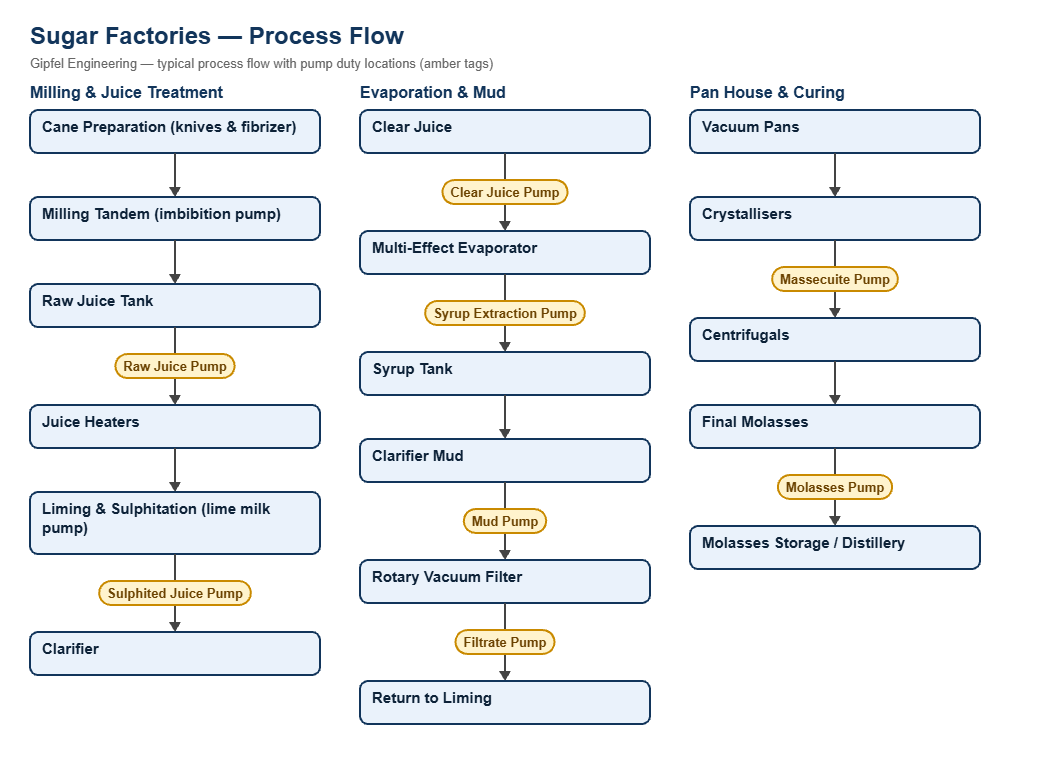
Process Overview
Cane Sugar Mill — Process Overview
Cane sugar manufacturing represents an arduous operational environment for rotating equipment. The combination of highly abrasive sand/soil grit in raw juice, fibrous bagasse solids, chemical scaling from lime milk and sulfur dioxide (SO2), extreme sucrose viscosities in massecuite, and high evaporator temperatures demands specialized mechanical sealing technologies to maintain uninterrupted 24/7 milling seasons (typically 120 to 180 days).
Primary Production Routes Covered:
- Sugarcane Processing: Cane preparation (knives/shredders), milling tandems or diffuser extraction, juice heating, defecation/carbonatation/sulfitation, clarification, multi-effect evaporation (MEE), vacuum pan crystallization, centrifugal separation, and molasses handling.
- Refined Sugar: remelt, affination, decolourisation and refined sugar boiling are covered on the Sugar Refinery page.
- Integrated Co-Gen & Distillery Utilities: High-pressure bagasse-fired boilers (67 to 110 bar), steam condensate recovery, turbine loops, and spent wash bio-methanation. See also our power generation and distillery & ethanol solutions.
Related: Sugar Refinery · Molasses-Based Distillery · Co-Generation & Biomass Power.
What mechanical seal is best for sugar mill raw juice and syrup pumps?
Sugar mill raw juice and MEE syrup pumps are typically fitted with cartridge mechanical seals with non-clogging wave springs or dual pressurised barriers. For abrasive raw juice containing bagasse fibre and sand grit, a single cartridge with monolithic silicon carbide faces, an API Plan 32 clean-water injection and a Plan 62 water quench is a common choice. For concentrated sugar syrup (60–65° Brix) operating under vacuum, a dual pressurised cartridge seal with an API Plan 53A barrier fluid system prevents syrup crusting at the atmospheric side and protects the faces from dry running.
Root-Cause Failure Analysis — Field Example
Symptom: Evaporator Syrup Extraction Pump seal leaks heavily after cold weekend stops; faces are glued shut.
  ├── Diagnostic Evidence Required:
  │     ├── Inspect atmospheric side of seal: Is sticky brown caramel/crystalline sucrose present?
  │     ├── Check seal chamber temperature during shutdown: Did the syrup cool, thicken and start to crystallise?
  │     ├── Inspect O-rings: Is dynamic O-ring hardened and glued to sleeve?
  └── Engineered Solution:
        ├── Replace single seals with a Gipfel dual pressurised cartridge seal operating on API Plan 53A.
        ├── Maintain continuous barrier water circulation through the thermosyphon pot during shutdown.
        ├── For single seal installations, fit an API Plan 62 hot-water quench on the atmospheric side and run it for about 15 minutes before shutdown and before start-up.
Operational & Environmental Benefits
- Lower water loss and juice dilution in milling tandems: Converting raw-juice pumps from gland packing to mechanical seals removes continuous gland-flush water, which otherwise dilutes juice and adds evaporator steam load.
- Reduced sugar loss and crusting at syrup pumps: Dual seals with a pressurised barrier stop syrup leaking to atmosphere, where it crusts and holds the faces.
Frequently Asked Questions
Why do mechanical seals clog in sugar mill raw juice pumps?
Raw juice contains long bagasse fibres and abrasive soil sand. Conventional multi-spring seals clog because fibres wrap around the small springs, causing dynamic O-ring hang-up. A Gipfel wave-spring slurry cartridge seal uses a single heavy-duty wave spring kept clear of the product flow, combined with hard silicon carbide faces that resist sand erosion.
How to prevent sugar crystallization on MEE syrup pump seal faces?
Evaporator syrup (65° Brix) crystallises and hardens when it leaks to atmosphere and loses water. A Gipfel dual pressurised cartridge seal with an API Plan 53A thermosyphon pot circulates clean barrier water between the inner and outer seals, isolating the hot syrup from the atmosphere and preventing face gluing.
Request a Seal Selection
Send your pump make and model, fluid, temperature, pressure, shaft size and speed to info@gipfelengg.com or use our enquiry form. Gipfel Engineering (ISO 9001:2015, NSIC-registered MSME, Mumbai) designs and manufactures mechanical seals, seal support systems and process pumps.
Equipment solutions: Overhung Pumps · Positive Displacement Pumps · Boiler Feed & Multistage Pumps · Turbines.
Pump Duty & Mechanical Seal Selection Matrix
Typical values for selection guidance only. Final selection is made against the customer duty sheet.
| Pump duty | Fluid | Typical temp. | Typical pressure (bar) | Seal arrangement | Faces / elastomer | API piping plan |
|---|---|---|---|---|---|---|
| Raw Juice Pump | Unscreened Raw Cane Juice | 30–45°C | 3.5–5.0 | Wave Spring Single Cartridge (Slurry Design) | Solid Sintered Silicon Carbide vs Sintered Silicon Carbide / FKM (Viton) | API Plan 32 (clean water injection) + Plan 62 (water quench); Plan 02 where no clean water is available |
| Imbibition Water Pump | Hot Process Condensate | 75–85°C | 4.0–6.0 | Single Spring Component / Cartridge | Carbon vs Silicon Carbide / EPDM | API Plan 11 |
| Sulfited / Defecated Juice Pump | Limed & Sulfited Juice | 70–80°C | 3.5–5.5 | Single Balanced Cartridge with Throttle Bushing | Silicon Carbide vs Silicon Carbide / EPDM (Hot Water Grade) | API Plan 32 preferred (precipitate-laden juice), or Plan 11 + Plan 62 atmospheric quench |
| Clarifier Mud / Cachaza Pump | Concentrated Underflow Mud | 85–95°C | 4.0–6.5 | Heavy Duty Slurry Single Cartridge (catalogue ref. HS860) | Solid Tungsten Carbide (Nickel Binder) vs Sintered Silicon Carbide / Aflas | API Plan 32 (regulated clean water injection, typically ~1 bar / 15 psi above seal-chamber pressure) |
| Rotary Vacuum Filter Filtrate Pump | Mud Filtrate with Entrained Air | 75–85°C | -0.6 to +3.0 bar | Dual Pressurised Cartridge | Silicon Carbide vs Premium Carbon / FKM | API Plan 53A (barrier ≥ 1.4 bar / 20 psi above seal-chamber pressure) |
| Milk of Lime (Lime Slurry) Pump | Slaked Lime Slurry [Ca(OH)2] | Ambient | 3.0–4.5 | External Spring Slurry Cartridge (catalogue ref. HS860) | Tungsten Carbide vs Sintered Silicon Carbide / EPDM / PTFE | API Plan 32 or Plan 62 |
| Clear Juice Pump | Clarified Thin Juice | 95–102°C | 3.5–5.0 | Single Balanced High-Temp Cartridge | Sintered Silicon Carbide vs food-grade resin-impregnated carbon / EPDM (hot-water grade) or Aflas | API Plan 11 + Plan 62 hot-water quench (seal-chamber pressure gives adequate margin above vapour pressure; a Plan 21 cooler scales in juice service) |
| MEE Evaporator Syrup Extraction Pump | Concentrated Sugar Syrup | 70–85°C | -0.85 bar (Vac) to +4.0 bar | Double Cartridge Multi-Spring (Dual Pressurised) | Silicon Carbide vs Silicon Carbide / Aflas | API Plan 53A (water barrier ≥ 1.4 bar / 20 psi above seal-chamber pressure) |
| Massecuite Transfer Pump (A, B, C) | Massecuite (Crystal + Molasses) | 55–70°C | 6.0–10.0 bar (rotary positive-displacement pump; many sites use gland packing — confirm seal retrofit with pump OEM) | Heavy-Duty Dual Cartridge Seal | Tungsten Carbide vs Tungsten Carbide / Aflas | API Plan 54 (external pressurised barrier water circulation) |
| Final Molasses Transfer Pump | ‘C’ Heavy Final Molasses | 40–55°C | 5.0–8.0 bar | Wave Spring Heavy Viscosity Cartridge | Silicon Carbide vs Silicon Carbide / FKM | Plan 11 (or Plan 02 with heated seal chamber) + Plan 62 steam/hot-water quench |
| Sweet Water / Condensate Pump | Evaporator Sweet Condensate | 60–90°C | 2.5–4.0 | Single Balanced Cartridge | Premium Resin Carbon vs Sintered Silicon Carbide / EPDM | API Plan 11 |
Reviewed by Gipfel Engineering’s technical team.
Technical Information Disclaimer
The information on this page, including process descriptions, flow diagrams, operating ranges, seal arrangements, materials and piping plans, is general technical guidance for information only. Values shown are typical industry ranges, not guaranteed ratings or specifications of any Gipfel Engineering product. Each application differs. Seal selection, material compatibility, installation and operation must be verified by qualified personnel against the specific equipment data sheet, process conditions, applicable codes and the pump manufacturer’s instructions. A binding recommendation is given only in a written quotation or technical offer from Gipfel Engineering.
References to standards (such as API 682, ISO 21049, ISO 3069, FDA 21 CFR 177.2600 and NACE MR0175 / ISO 15156) describe common industry practice. They do not mean that any product is certified, qualified or approved to that standard unless this is confirmed in writing for a specific order. Third-party company and product names, including “equivalent to” references, are used for identification only and remain the trademarks of their owners. No affiliation, endorsement or OEM approval is implied.
Compliance with safety, hazardous-area, environmental and statutory requirements at the user’s site remains the responsibility of the plant owner or operator. To the extent permitted by law, Gipfel Engineering accepts no liability for loss or damage arising from reliance on this general information without a confirmed written recommendation. Content may change without notice.