
Pipelines, Terminals & LPG
Process Overview
Pipelines, Terminals & LPG — Process Overview
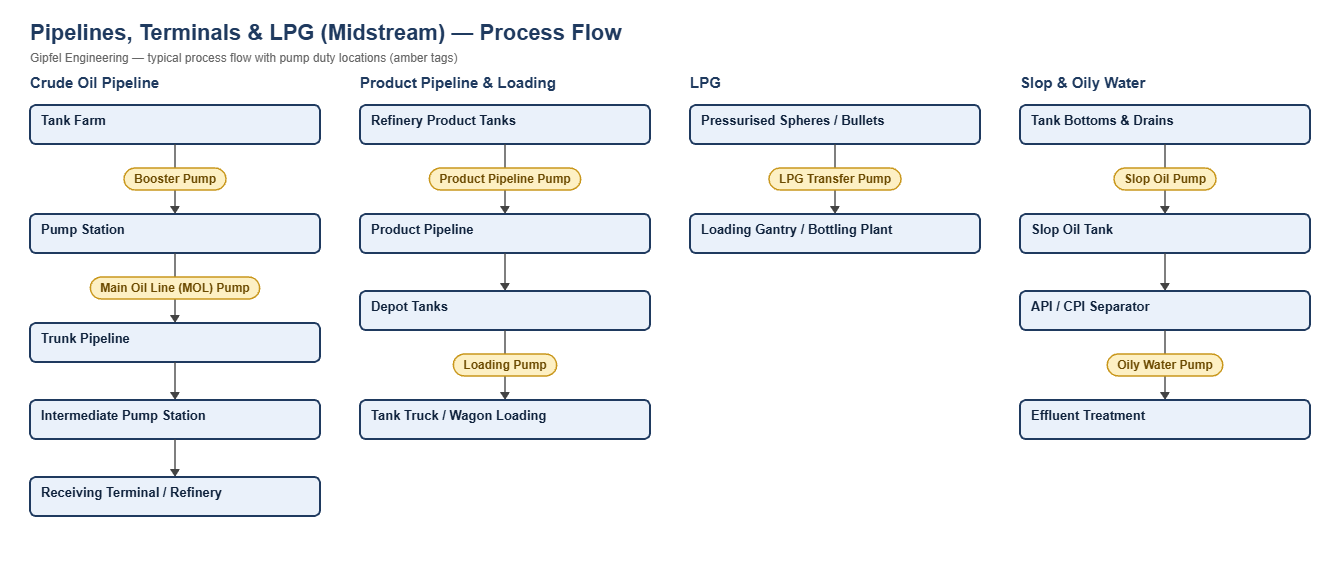
Midstream assets move crude oil, refined products and LPG between fields, refineries, depots and customers. Crude is boosted from tank farms into main oil line pumps at pipeline stations; products are pumped through multi-product pipelines to depots and loaded into tank trucks and wagons; LPG is stored under pressure in spheres or bullets and transferred to loading gantries and bottling plants. Slop oil and oily water from tank bottoms and drains are recovered and treated.
For production facilities see Upstream Oil & Gas Production; for refinery units see Refinery.
Key Sealing Challenges
- Continuous duty: pipeline pumps run for long periods at high flow; seal life sets maintenance intervals.
- High pressure in series: in multi-pump stations each pump sees a higher suction pressure; the seal is rated for its own seal-chamber pressure.
- Volatile fluids: LPG and petrol flash at atmospheric pressure; tandem seals with an API Plan 52 buffer control emissions.
- Ethanol-blended petrol: E20 petrol needs elastomer grades compatible with ethanol.
What mechanical seal is used on crude oil pipeline pumps?
Main oil line pumps typically use an API 682 cartridge seal, Arrangement 1, with silicon carbide vs. carbon faces on an API Plan 11 flush. Where emission rules require, an Arrangement 2 tandem seal with a Plan 52 buffer is used. The seal is sized for seal-chamber pressure, which in series stations is higher for each downstream pump.
Root-Cause Failure Analysis — Field Example
Symptom: LPG loading pump seal leaks and squeals after every stop and restart.
  ├── Incorrect Response: "Increase spring load."
  ├── Diagnostic Evidence Required:
  │     ├── Does seal-chamber pressure fall towards vapour pressure during start-up, letting LPG flash at the faces?
  │     ├── Is the Plan 11 flush orifice blocked or undersized?
  │     └── Was the pump casing vented and filled with liquid before start?
  └── Engineered Solution:
        ├── Restore seal-chamber pressure margin above vapour pressure with a correctly sized Plan 11 flush.
        ├── Tandem seal (Arrangement 2) with a Plan 52 buffer vented to flare or recovery.
        └── Vent and fill the pump completely before every start.
Frequently Asked Questions
When is an Arrangement 2 tandem seal needed instead of a single seal?
Where the fluid is volatile or hazardous and local emission rules limit leakage to atmosphere, such as LPG and petrol. The outer seal and Plan 52 buffer contain any inner-seal leakage and route vapour to flare or recovery.
Does E20 petrol affect seal elastomers?
Ethanol in blended petrol can swell some standard elastomer grades. FKM grades approved for ethanol blends should be specified for petrol pipeline and loading pumps.
Related: Upstream Oil & Gas Production · Refinery · Biofuels · Marine.
Request a Seal Selection
Send your pump make and model, fluid, temperature, pressure, shaft size and speed to info@gipfelengg.com or use our enquiry form. Gipfel Engineering (ISO 9001:2015, NSIC-registered MSME, Mumbai) designs and manufactures mechanical seals, seal support systems and process pumps.
Equipment solutions: Split-Case Pumps · Vertical & Sump Pumps · Compressors & Bearing Chambers.
Pump Duty & Mechanical Seal Selection Matrix
Typical values for selection guidance only. Final selection is made against the customer duty sheet.
| Pump duty | Fluid | Typical temp. | Typical pressure (bar) | Seal arrangement | Faces / elastomer | API piping plan |
|---|---|---|---|---|---|---|
| Main Oil Line (MOL) Pipeline Pump | Stabilised crude oil | 35–65 °C | Discharge 60–120 bar. The seal sees seal-chamber pressure; for pumps in series, rate the seal for the highest suction pressure | API 682 cartridge seal (Arrangement 1); Tandem double cartridge (Arrangement 2) where emission rules require | SiC vs carbon / FKM or FEPM (Aflas) | API Plan 11; Plan 11 + Plan 52 for Arrangement 2 |
| Tank Farm Booster Pump | Stabilised crude oil | Ambient–60 °C | Suction at tank head; discharge 10–25 bar | API 682 cartridge seal (Arrangement 1) | SiC vs carbon / FKM | API Plan 11 |
| Product Pipeline Pump | Diesel, petrol, ATF, kerosene | Ambient | Discharge 40–100 bar; the seal sees seal-chamber pressure | API 682 cartridge seal (Arrangement 1); Tandem double cartridge (Arrangement 2) for petrol where emission rules require | SiC vs carbon / FKM (ethanol-blend compatible grade for E20 petrol) | API Plan 11; Plan 11 + Plan 52 for Arrangement 2 |
| Tank Truck / Wagon Loading Pump | Petrol, diesel, ATF | Ambient | 3–8 bar | Balanced multi-spring cartridge; Tandem double cartridge (Arrangement 2) for petrol where required | SiC vs carbon / FKM (ethanol-blend compatible grade) | API Plan 11 |
| LPG Transfer / Loading Pump | Propane / butane mixture | Ambient (pressurised storage) | Vapour pressure plus head; keep seal-chamber pressure margin above vapour pressure | Tandem double cartridge (Arrangement 2) | Carbon vs SiC / FKM (low-temperature grade) | API Plan 11 + Plan 52 (buffer vapour to flare or recovery) |
| Slop Oil Pump | Slop oil with water and sediment | 30–60 °C | 2–6 bar | Balanced multi-spring cartridge | SiC vs SiC / FKM | API Plan 11; Plan 32 (clean oil flush) where solids are heavy |
| Oily Water / API Separator Pump | Oily water | Ambient–50 °C | 2–5 bar | Wave-spring semi-cartridge | SiC vs SiC / FKM | API Plan 11 |
Reviewed by Gipfel Engineering’s technical team.
Technical Information Disclaimer
The information on this page, including process descriptions, flow diagrams, operating ranges, seal arrangements, materials and piping plans, is general technical guidance for information only. Values shown are typical industry ranges, not guaranteed ratings or specifications of any Gipfel Engineering product. Each application differs. Seal selection, material compatibility, installation and operation must be verified by qualified personnel against the specific equipment data sheet, process conditions, applicable codes and the pump manufacturer’s instructions. A binding recommendation is given only in a written quotation or technical offer from Gipfel Engineering.
References to standards (such as API 682, ISO 21049, ISO 3069, FDA 21 CFR 177.2600 and NACE MR0175 / ISO 15156) describe common industry practice. They do not mean that any product is certified, qualified or approved to that standard unless this is confirmed in writing for a specific order. Third-party company and product names, including “equivalent to” references, are used for identification only and remain the trademarks of their owners. No affiliation, endorsement or OEM approval is implied.
Compliance with safety, hazardous-area, environmental and statutory requirements at the user’s site remains the responsibility of the plant owner or operator. To the extent permitted by law, Gipfel Engineering accepts no liability for loss or damage arising from reliance on this general information without a confirmed written recommendation. Content may change without notice.