
Refinery Crude, Vacuum & Conversion Units
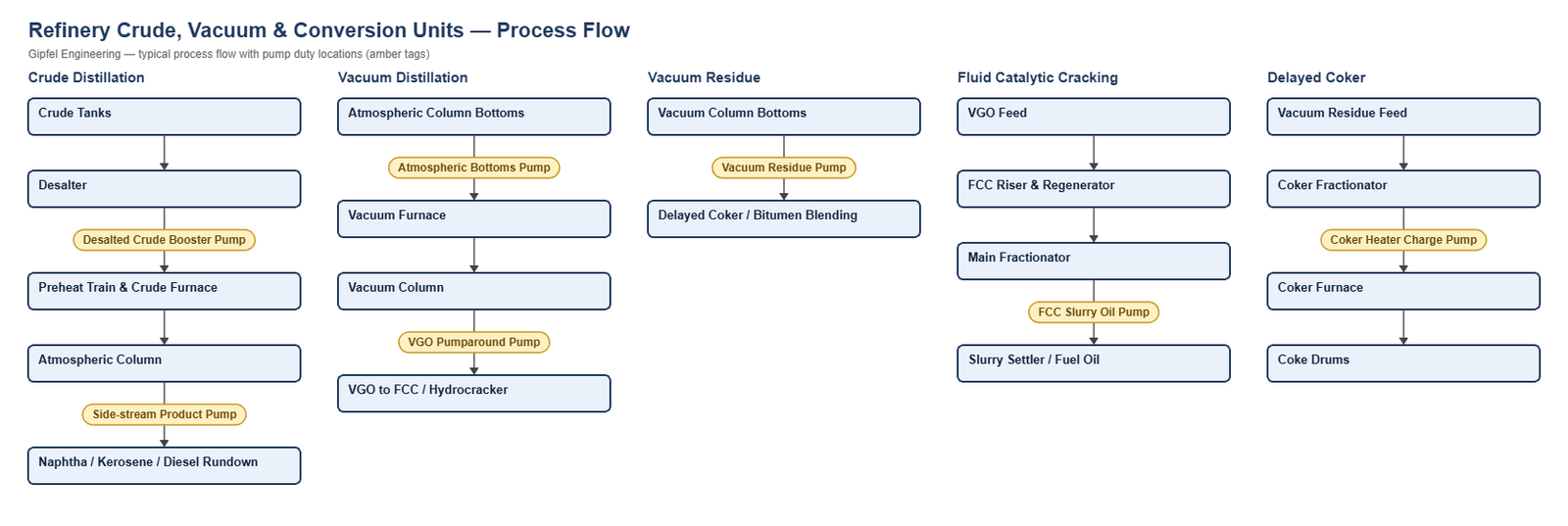
Process Overview
Refinery Crude, Vacuum & Conversion Units — Process Overview
Crude oil is desalted, preheated and fractionated in the atmospheric column into naphtha, kerosene, diesel and reduced crude. The reduced crude is distilled again under vacuum to recover vacuum gas oil (VGO), which feeds the fluid catalytic cracker (FCC) or hydrocracker, while vacuum residue goes to the delayed coker or bitumen. These units handle the hottest, heaviest streams in the refinery, often with catalyst or coke fines.
For amine, sour water, hydrotreating, LPG and sulphur recovery see Refinery Treating & Light Ends.
Key Sealing Challenges
- Temperature: bottoms services run at 300–400 °C, above the limit of elastomers; metal bellows seals with flexible graphite secondary seals are used.
- Coking: oil that weeps across the faces cokes in air. An API Plan 62 steam quench removes it from the atmospheric side.
- Solids: FCC catalyst fines and coke particles need hard face pairs and a clean flush (API Plan 32).
- Low suction pressure: vacuum column bottoms pumps have little margin above vapour pressure at the seal.
What mechanical seal is used on refinery hot oil and bottoms pumps?
Refinery bottoms pumps above about 260 °C typically use metal bellows seals (API 682 Type C) with flexible graphite secondary seals, because elastomers cannot survive the temperature. Faces are SiC vs carbon on clean oil and SiC vs SiC where catalyst or coke fines are present. An API Plan 32 cool flush or Plan 23 cooling protects the faces, and an API Plan 62 steam quench prevents coking on the atmospheric side.
Root-Cause Failure Analysis — Field Example
Symptom: Vacuum residue pump seal leaks within weeks; bellows stiff, hard black deposits on the atmospheric side.
  ├── Incorrect Response: "Change to a pusher seal with harder faces."
  ├── Diagnostic Evidence Required:
  │     ├── Is the Plan 62 steam quench connected, trapped and flowing continuously?
  │     ├── Is the Plan 32 flush oil flowing at the required rate and pressure above seal-chamber pressure?
  │     └── Inspect bellows convolutions for coke packing and loss of spring rate.
  └── Engineered Solution:
        ├── Restore a continuous low-pressure Plan 62 steam quench with a condensate drain.
        ├── Regulate the Plan 32 gas-oil flush and confirm its pressure margin.
        └── Metal bellows seal with flexible graphite secondary seals and SiC vs SiC faces.
Frequently Asked Questions
Why are metal bellows seals used for hot oil instead of pusher seals?
A metal bellows replaces both the springs and the dynamic O-ring, so there is no elastomer to fail at high temperature and no sliding secondary seal to hang up on coke. Flexible graphite is used for the static seals.
What does an API Plan 62 steam quench do?
Low-pressure steam is fed to the atmospheric side of the seal, behind the faces. It carries away oil that weeps across the faces before it can cool and coke, and drains as condensate.
Related: Refinery Treating & Light Ends · Upstream Oil & Gas · Pipelines, Terminals & LPG · Biofuels.
Request a Seal Selection
Send your pump make and model, fluid, temperature, pressure, shaft size and speed to info@gipfelengg.com or use our enquiry form. Gipfel Engineering (ISO 9001:2015, NSIC-registered MSME, Mumbai) designs and manufactures mechanical seals, seal support systems and process pumps.
Equipment solutions: Overhung Pumps · Split-Case Pumps · Boiler Feed & Multistage Pumps.
Pump Duty & Mechanical Seal Selection Matrix
Typical values for selection guidance only. Final selection is made against the customer duty sheet.
| Pump duty | Fluid | Typical temp. | Typical pressure (bar) | Seal arrangement | Faces / elastomer | API piping plan |
|---|---|---|---|---|---|---|
| Desalted Crude Booster Pump | Desalted crude oil | 120–150 °C | Seal-chamber pressure — confirm per pump | API 682 cartridge seal (Arrangement 1) | SiC vs carbon / FKM or FEPM (Aflas) | API Plan 11, or Plan 23 where temperature approaches the elastomer limit |
| Side-stream Product Pump (naphtha, kerosene, diesel) | Hot distillates | 150–250 °C | 5–15 bar | Metal bellows seal (API 682 Type C, rotating or stationary bellows) | SiC vs carbon / flexible graphite secondary seals | API Plan 23 (or Plan 11 for lighter, cooler cuts) |
| Atmospheric Bottoms Pump | Reduced crude | 330–370 °C | 5–15 bar | Metal bellows seal (API 682 Type C, rotating or stationary bellows) | SiC vs carbon / flexible graphite | API Plan 32 (cool flushing oil) or Plan 23, + Plan 62 steam quench against coking |
| VGO Pumparound Pump | Vacuum gas oil | 250–320 °C | Suction from vacuum column; low seal-chamber pressure — confirm per pump | Metal bellows seal (API 682 Type C, rotating or stationary bellows) | SiC vs carbon / flexible graphite | API Plan 23 + Plan 62 steam quench |
| Vacuum Residue Pump | Vacuum residue, very viscous | 350–400 °C | Suction from vacuum column; low seal-chamber pressure — confirm per pump | Metal bellows seal (API 682 Type C, rotating or stationary bellows) | SiC vs SiC or SiC vs tungsten carbide / flexible graphite | API Plan 32 (gas-oil flush) + Plan 62 steam quench |
| FCC Slurry Oil Pump | Main fractionator bottoms with catalyst fines | 330–370 °C | 5–15 bar | Metal bellows seal (API 682 Type C, rotating or stationary bellows) | SiC vs SiC (hard pair for catalyst fines) / flexible graphite | API Plan 32 (clean flushing oil) + Plan 62 steam quench |
| Coker Heater Charge Pump | Coker fractionator bottoms with coke fines | 300–370 °C | Discharge 30–60 bar; seal sees seal-chamber pressure — confirm per pump | Metal bellows seal (API 682 Type C, rotating or stationary bellows) | SiC vs SiC / flexible graphite | API Plan 32 + Plan 62 steam quench |
Reviewed by Gipfel Engineering’s technical team.
Technical Information Disclaimer
The information on this page, including process descriptions, flow diagrams, operating ranges, seal arrangements, materials and piping plans, is general technical guidance for information only. Values shown are typical industry ranges, not guaranteed ratings or specifications of any Gipfel Engineering product. Each application differs. Seal selection, material compatibility, installation and operation must be verified by qualified personnel against the specific equipment data sheet, process conditions, applicable codes and the pump manufacturer’s instructions. A binding recommendation is given only in a written quotation or technical offer from Gipfel Engineering.
References to standards (such as API 682, ISO 21049, ISO 3069, FDA 21 CFR 177.2600 and NACE MR0175 / ISO 15156) describe common industry practice. They do not mean that any product is certified, qualified or approved to that standard unless this is confirmed in writing for a specific order. Third-party company and product names, including “equivalent to” references, are used for identification only and remain the trademarks of their owners. No affiliation, endorsement or OEM approval is implied.
Compliance with safety, hazardous-area, environmental and statutory requirements at the user’s site remains the responsibility of the plant owner or operator. To the extent permitted by law, Gipfel Engineering accepts no liability for loss or damage arising from reliance on this general information without a confirmed written recommendation. Content may change without notice.