
Biotech & Sterile Manufacturing
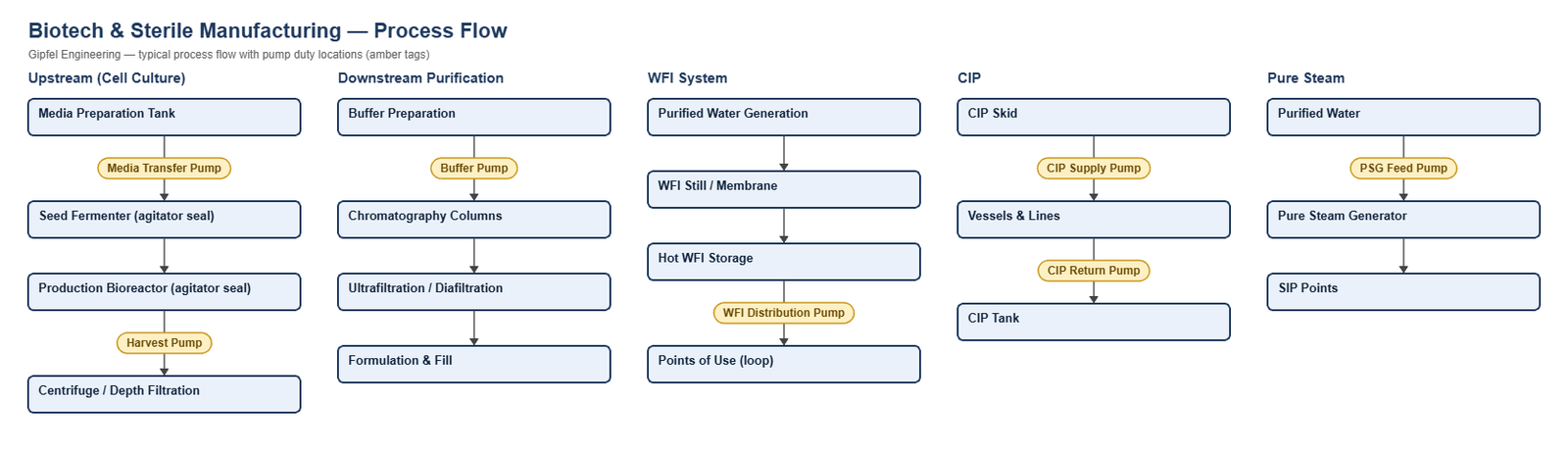
Process Overview
Biotech & Sterile Manufacturing — Process Overview
Biotech plants grow cells or microorganisms in sterile bioreactors and fermenters to produce vaccines, enzymes, monoclonal antibodies and other biologics. Media is prepared and sterilised, the culture is grown under controlled aeration and agitation, and the harvest is clarified and purified by chromatography and ultrafiltration before formulation and fill. Water for injection (WFI), clean-in-place (CIP) and pure steam for sterilise-in-place (SIP) support every step.
For chemical synthesis of drug substances see API & Bulk Drug Manufacturing.
Key Sealing Challenges
- Sterility: agitator seals on bioreactors must keep the culture sterile and withstand repeated SIP at 121–135 °C.
- Hygienic design: seal chambers must be drainable and free of dead zones, with no particles shed into the product.
- Compliance: wetted elastomers must meet FDA 21 CFR 177.2600 and USP Class VI.
- Cleaning chemicals: CIP caustic and acids at 70–85 °C require sintered SiC faces and EPDM.
What mechanical seal is used on bioreactor and fermenter agitators?
Bioreactor agitators typically use a hygienic double mechanical seal with a sterile barrier held above vessel pressure, SiC faces and FDA / USP Class VI elastomers. The barrier stops contamination entering the vessel, and the seal is designed to withstand sterilise-in-place (SIP) at 121–135 °C.
Root-Cause Failure Analysis — Field Example
Symptom: Fermenter batches become contaminated after a seal change.
  ├── Incorrect Response: "Increase the SIP time."
  ├── Diagnostic Evidence Required:
  │     ├── Is the barrier held above vessel pressure through SIP, cool-down and batch operation?
  │     ├── Inspect the seal chamber for dead zones and undrained pockets after SIP.
  │     └── Check the elastomers for compression set after repeated SIP cycles.
  └── Engineered Solution:
        ├── Hygienic double seal with a sterile barrier held above vessel pressure at all times.
        ├── Drainable seal chamber geometry; validate SIP temperature at the seal.
        └── Elastomers rated for repeated SIP (EPDM or FFKM, FDA / USP Class VI).
Frequently Asked Questions
Why is SiC vs SiC used on WFI pumps?
A hard SiC face pair sheds far fewer particles than carbon, and WFI is a very poor lubricant at 65–85 °C. Sintered SiC also resists CIP chemicals.
Do hygienic seals need a quench?
Pumps on buffers and broths use a Plan 62 condensate or clean-steam quench to dissolve crystals and keep the atmospheric side sterile. WFI pumps normally run without an external flush in a self-draining seal chamber.
Related: API & Bulk Drug Manufacturing · Food & Dairy · General Chemical Plants.
Request a Seal Selection
Send your pump make and model, fluid, temperature, pressure, shaft size and speed to info@gipfelengg.com or use our enquiry form. Gipfel Engineering (ISO 9001:2015, NSIC-registered MSME, Mumbai) designs and manufactures mechanical seals, seal support systems and process pumps.
Equipment solutions: Fermenters · Agitators · Positive Displacement Pumps.
Pump Duty & Mechanical Seal Selection Matrix
Typical values for selection guidance only. Final selection is made against the customer duty sheet.
| Equipment / duty | Fluid | Typical temp. | Typical pressure (bar) | Seal arrangement | Faces / elastomer | API piping plan |
|---|---|---|---|---|---|---|
| Bioreactor / Fermenter Agitator | Sterile culture broth | 30–37 °C in process; 121–135 °C during SIP | 0–3 bar | Hygienic double seal for fermenters / bioreactors | SiC vs carbon or SiC vs SiC / EPDM or FFKM (FDA 21 CFR 177.2600 / USP Class VI) | Sterile barrier above vessel pressure (sterile gas or condensate, per seal design); SIP-capable |
| Media Transfer / Harvest Pump | Culture media or harvest broth | 4–37 °C | 1–4 bar | Single-spring cartridge | SiC vs carbon / EPDM (FDA) | Plan 62 sterile condensate or clean steam quench |
| WFI / Purified Water Distribution Pump | Water for injection, hot loop | 65–85 °C | 3–6 bar | Single-spring cartridge in a hygienic, drainable seal chamber | SiC vs SiC / EPDM (FDA, USP Class VI) | No external flush; seal chamber self-draining and SIP-capable |
| Chromatography Buffer / Process Liquid Pump | Salt and phosphate buffers | 4–25 °C | 2–6 bar | Single-spring cartridge | SiC vs SiC / EPDM (FDA) | Plan 62 purified water quench against salt crystals |
| CIP Supply / Return Pump | 1–2 % NaOH, nitric or phosphoric acid, hot water | 70–85 °C | 3–5 bar | Single-spring cartridge | Sintered SiC vs sintered SiC / EPDM | No external flush; return pumps must handle entrained air |
| Pure Steam Generator Feed Pump | Purified water | 20–90 °C | 5–10 bar | Single-spring cartridge | SiC vs SiC / EPDM (FDA) | API Plan 11 |
Reviewed by Gipfel Engineering’s technical team.
Technical Information Disclaimer
The information on this page, including process descriptions, flow diagrams, operating ranges, seal arrangements, materials and piping plans, is general technical guidance for information only. Values shown are typical industry ranges, not guaranteed ratings or specifications of any Gipfel Engineering product. Each application differs. Seal selection, material compatibility, installation and operation must be verified by qualified personnel against the specific equipment data sheet, process conditions, applicable codes and the pump manufacturer’s instructions. A binding recommendation is given only in a written quotation or technical offer from Gipfel Engineering.
References to standards (such as API 682, ISO 21049, ISO 3069, FDA 21 CFR 177.2600 and NACE MR0175 / ISO 15156) describe common industry practice. They do not mean that any product is certified, qualified or approved to that standard unless this is confirmed in writing for a specific order. Third-party company and product names, including “equivalent to” references, are used for identification only and remain the trademarks of their owners. No affiliation, endorsement or OEM approval is implied.
Compliance with safety, hazardous-area, environmental and statutory requirements at the user’s site remains the responsibility of the plant owner or operator. To the extent permitted by law, Gipfel Engineering accepts no liability for loss or damage arising from reliance on this general information without a confirmed written recommendation. Content may change without notice.