
Dairy Processing
Process Overview
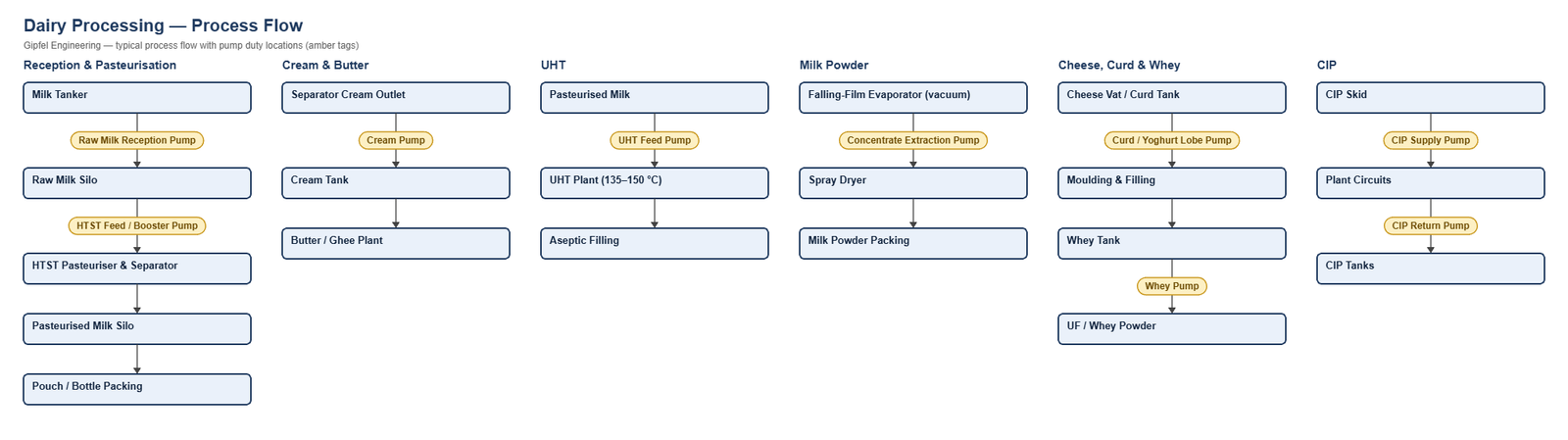
Dairy Processing — Process Overview
Dairy plants receive raw milk, chill and store it, then separate cream and pasteurise the milk in HTST (high-temperature short-time) plants at 72–85 °C or sterilise it in UHT plants at 135–150 °C for aseptic packing. Milk is also concentrated in falling-film evaporators and spray-dried to powder, or set into curd, yoghurt and cheese, leaving whey for further processing. Every circuit is cleaned in place (CIP) daily.
For breweries, soft drinks and juice see Beverage & Brewery; for vegetable oil refining see Edible Oil Refinery.
Key Sealing Challenges
- Hygiene: seals must be cleanable, drainable and free of dead zones, with FDA-compliant elastomers.
- Protein fouling: hot milk forms milk-stone on the faces and atmospheric side; hard SiC pairs and a quench prevent build-up.
- Aseptic duty: UHT product pumps need a sterile barrier so no microorganisms enter past the seal.
- Daily CIP: hot caustic and acid cleaning calls for sintered SiC faces and EPDM.
What mechanical seal is used on dairy milk pumps?
Dairy centrifugal pumps typically use a hygienic single cartridge seal with FDA-compliant EPDM: SiC vs carbon on cold milk, and SiC vs SiC with a Plan 62 hot-water quench on hot milk to stop milk-stone forming. UHT product pumps use an aseptic double seal with a sterile steam or condensate barrier.
Root-Cause Failure Analysis — Field Example
Symptom: HTST booster pump seal leaks within a month; brown deposits on the faces and around the seal.
  ├── Incorrect Response: "Change to harder springs."
  ├── Diagnostic Evidence Required:
  │     ├── Are the deposits milk-stone (denatured protein and calcium phosphate)?
  │     ├── Is the face pair SiC vs carbon running on milk above 72 °C?
  │     └── Is there a quench, and does CIP reach the atmospheric side?
  └── Engineered Solution:
        ├── SiC vs SiC face pair for hot milk.
        ├── Plan 62 hot-water or condensate quench to dissolve deposits.
        └── Hygienic seal chamber that CIP flow reaches fully.
Frequently Asked Questions
Why are FDA-compliant elastomers required?
Elastomers in contact with milk must not release harmful substances into food. EPDM grades complying with FDA 21 CFR 177.2600 are standard in dairy service.
Why does a UHT pump need a double seal?
After UHT treatment the product is sterile. A double seal with a sterile steam or condensate barrier prevents microorganisms entering the product past the seal faces.
Related: Beverage & Brewery · Edible Oil Refinery · Biotech & Sterile Manufacturing · Sugar Refinery.
Request a Seal Selection
Send your pump make and model, fluid, temperature, pressure, shaft size and speed to info@gipfelengg.com or use our enquiry form. Gipfel Engineering (ISO 9001:2015, NSIC-registered MSME, Mumbai) designs and manufactures mechanical seals, seal support systems and process pumps.
Equipment solutions: Positive Displacement Pumps · Mixers · Blenders.
Pump Duty & Mechanical Seal Selection Matrix
Typical values for selection guidance only. Final selection is made against the customer duty sheet.
| Pump duty | Fluid | Typical temp. | Typical pressure (bar) | Seal arrangement | Faces / elastomer | API piping plan |
|---|---|---|---|---|---|---|
| Raw Milk Reception / Transfer Pump | Raw milk | 4–10 °C | 2–4 bar | Single-spring cartridge (hygienic) | SiC vs carbon / EPDM (FDA 21 CFR 177.2600) | No external flush; hygienic seal chamber |
| HTST Feed / Hot Milk Booster Pump | Milk | 72–85 °C | 3–6 bar | Single-spring cartridge (hygienic) | SiC vs SiC / EPDM (FDA 21 CFR 177.2600) | Plan 62 hot-water or condensate quench against milk-stone build-up |
| UHT Product Pump | Milk or dairy beverage, sterile | 135–150 °C | 4–8 bar | Double cartridge, back-to-back (pressurised) (aseptic) | SiC vs SiC / EPDM (FDA 21 CFR 177.2600) | Sterile steam or condensate barrier, per aseptic design |
| Cream Pump | Cream | 40–55 °C | 2–4 bar | Single-spring cartridge (hygienic) | SiC vs carbon / EPDM (FDA 21 CFR 177.2600) | No external flush |
| Milk Concentrate Extraction Pump (evaporator) | Concentrated milk under vacuum | 45–70 °C | Suction under vacuum | Double cartridge, back-to-back (pressurised) | SiC vs SiC / EPDM (FDA 21 CFR 177.2600) | Pressurised potable-water barrier (Plan 53A) to stop air ingress and fouling |
| Curd / Yoghurt Pump (rotary lobe) | Curd, yoghurt, processed cheese; high viscosity | 4–45 °C | 3–8 bar | Single or double seal per lobe pump design | SiC vs SiC / EPDM (FDA 21 CFR 177.2600) | Plan 62 quench |
| Whey / Permeate Pump | Whey, mildly acidic | 10–50 °C | 2–4 bar | Single-spring cartridge (hygienic) | SiC vs carbon / EPDM (FDA 21 CFR 177.2600) | No external flush |
| CIP Supply / Return Pump | 1–2 % NaOH, nitric or phosphoric acid, hot water | 70–85 °C | 3–5 bar | Single-spring cartridge | Sintered SiC vs sintered SiC / EPDM | No external flush; return pumps must handle entrained air |
Reviewed by Gipfel Engineering’s technical team.
Technical Information Disclaimer
The information on this page, including process descriptions, flow diagrams, operating ranges, seal arrangements, materials and piping plans, is general technical guidance for information only. Values shown are typical industry ranges, not guaranteed ratings or specifications of any Gipfel Engineering product. Each application differs. Seal selection, material compatibility, installation and operation must be verified by qualified personnel against the specific equipment data sheet, process conditions, applicable codes and the pump manufacturer’s instructions. A binding recommendation is given only in a written quotation or technical offer from Gipfel Engineering.
References to standards (such as API 682, ISO 21049, ISO 3069, FDA 21 CFR 177.2600 and NACE MR0175 / ISO 15156) describe common industry practice. They do not mean that any product is certified, qualified or approved to that standard unless this is confirmed in writing for a specific order. Third-party company and product names, including “equivalent to” references, are used for identification only and remain the trademarks of their owners. No affiliation, endorsement or OEM approval is implied.
Compliance with safety, hazardous-area, environmental and statutory requirements at the user’s site remains the responsibility of the plant owner or operator. To the extent permitted by law, Gipfel Engineering accepts no liability for loss or damage arising from reliance on this general information without a confirmed written recommendation. Content may change without notice.