
Fertiliser Plant
Process Overview
Fertiliser Plant — Process Overview
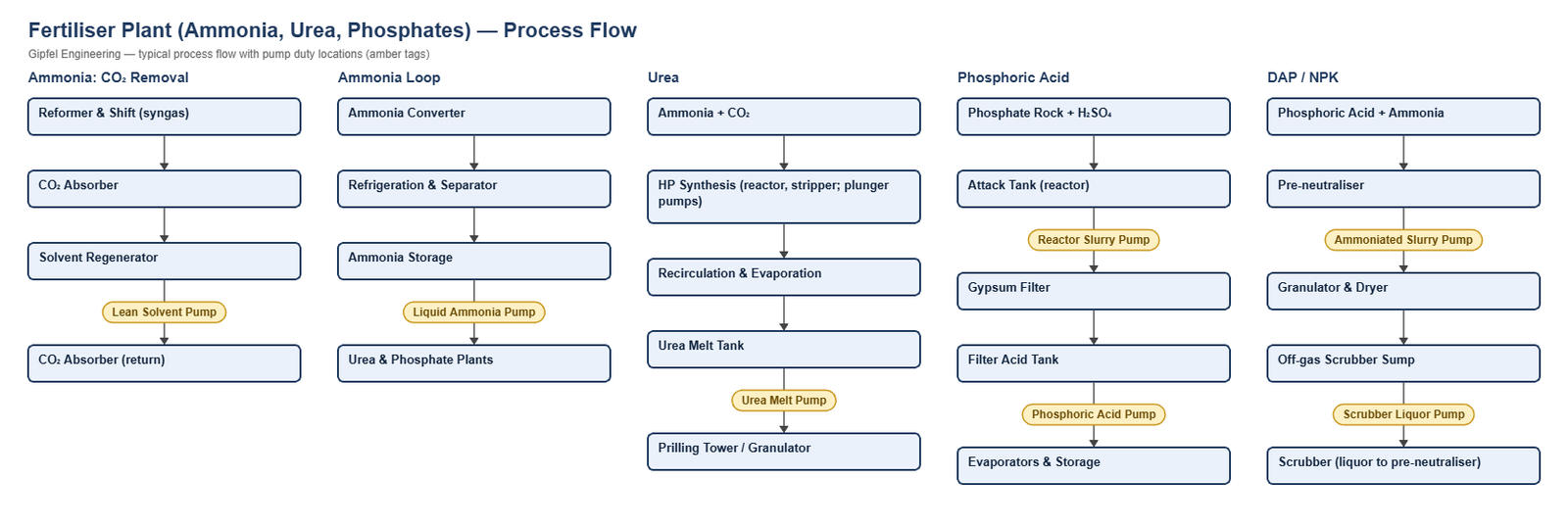
A fertiliser (fertilizer) complex typically combines ammonia, urea and phosphate units. In the ammonia plant, natural gas (or naphtha) is reformed to synthesis gas, CO₂ is removed by a hot potassium carbonate or amine solvent, and ammonia is synthesised and stored. The urea plant reacts ammonia with CO₂ at high pressure, then recovers, evaporates and prills or granulates the urea melt. Phosphate units react phosphate rock with sulphuric acid to make phosphoric acid, then ammoniate it to produce DAP, MAP or NPK granules.
For sulphuric acid production see Sulphuric Acid; for ammonia refrigeration systems see Ammonia Refrigeration.
Key Sealing Challenges
- Ammonia: toxic and attacks FKM and copper alloys. EPDM or chloroprene elastomers in a tandem seal with an API Plan 52 buffer are used.
- Crystallising fluids: carbonate solvent, urea melt and ammoniated slurry solidify on cooling, so steam-jacketed seal chambers and steam quench are applied.
- Phosphoric acid slurry: acid, fluorides and gypsum solids together need sintered SiC faces, high-alloy metal parts and a clean flush or pressurised barrier.
- HP urea synthesis: high-pressure ammonia and carbamate feed is usually handled by reciprocating plunger pumps with packing, not centrifugal mechanical seals.
What mechanical seal is used for liquid ammonia pumps in fertiliser plants?
Liquid ammonia pumps typically use a tandem double cartridge seal on API Plan 11 + Plan 52, with SiC vs. carbon faces and EPDM or chloroprene elastomers. FKM swells and fails in ammonia, and copper alloys are attacked, so neither is used. The buffer fluid must be compatible with ammonia and remain fluid at the operating temperature.
Root-Cause Failure Analysis — Field Example
Symptom: Phosphoric acid reactor slurry pump seal fails in 4–6 weeks; faces grooved, springs packed with solids.
  ├── Incorrect Response: "Fit a standard single seal with tungsten carbide faces."
  ├── Diagnostic Evidence Required:
  │     ├── Face material: cobalt-bound tungsten carbide is leached by the acid; carbon wears in gypsum slurry.
  │     ├── Flush: is the Plan 32 flow regulated and about 1 bar above seal-chamber pressure, or has it been throttled to reduce dilution?
  │     └── Springs: are they in the slurry, and are scale and gypsum deposits restricting them?
  └── Engineered Solution:
        ├── Slurry cartridge with external springs, sintered SiC vs sintered SiC faces.
        ├── Alloy 20 or Hastelloy C-276 metal parts for acid with fluorides.
        └── Regulated Plan 32 flush, or a double seal with Plan 53A where dilution is not acceptable.
Frequently Asked Questions
Why are FKM elastomers not used in ammonia service?
Ammonia and amines attack fluoroelastomers (FKM), causing swelling, hardening and loss of sealing force. EPDM or chloroprene (Neoprene) elastomers are used, and copper-alloy seal parts are avoided.
Which seal suits urea melt pumps?
A metal bellows seal with sintered SiC faces in a steam-jacketed seal chamber (API Plan 02) with an API Plan 62 steam quench keeps the urea molten at the faces and prevents crystals forming on the atmospheric side.
Related: Sulphuric Acid · Chlor-Alkali · General Chemical Plants · Mining Slurry.
Request a Seal Selection
Send your pump make and model, fluid, concentration, temperature, pressure, shaft size and speed to info@gipfelengg.com or use our enquiry form. Gipfel Engineering (ISO 9001:2015, NSIC-registered MSME, Mumbai) designs and manufactures mechanical seals, seal support systems and process pumps.
Equipment solutions: Overhung Pumps · Boiler Feed & Multistage Pumps · Compressors & Bearing Chambers · Slurry Pumps.
Pump Duty & Mechanical Seal Selection Matrix
Typical values for selection guidance only. Final selection is made against the customer duty sheet.
| Pump duty | Fluid | Typical temp. | Typical pressure (bar) | Seal arrangement | Faces / elastomer | API piping plan |
|---|---|---|---|---|---|---|
| Liquid Ammonia Transfer / Loading Pump | Liquid ammonia | −33 °C (refrigerated storage) to ambient (pressurised) | Vapour pressure + head; up to about 20 bar | Tandem double cartridge | SiC vs carbon / EPDM or chloroprene (not FKM); no copper-alloy parts | API Plan 11 + Plan 52 (unpressurised buffer fluid compatible with ammonia and the operating temperature) |
| Lean / Semi-Lean Solvent Pump (CO₂ removal) | Hot potassium carbonate (Benfield) or activated MDEA solution | 70–120 °C | Seal sees suction (regenerator) pressure; discharge to absorber pressure — confirm per pump | Balanced multi-spring cartridge | Sintered SiC vs sintered SiC / EPDM (amine-compatible grade) or FFKM | API Plan 11 + Plan 62 steam or water quench against crystallisation |
| Boiler Feed Pump (ammonia plant steam system) | Deaerated feedwater | 105–160 °C | Seal sees seal-chamber (suction / balance-line) pressure, not discharge — confirm per pump | High-pressure balanced cartridge, stationary springs (catalogue ref. HP760) | Reaction-bonded SiC vs carbon / EPDM (peroxide-cured) or FEPM (Aflas) | API Plan 23 |
| Urea Melt / Urea Solution Pump | Urea solution or melt with traces of ammonia and carbamate | 80–140 °C (melt crystallises on cooling) | 2–8 bar | Metal bellows seal with urea-grade 316L or duplex metal parts | Sintered SiC vs sintered SiC / flexible graphite or FFKM | API Plan 02 (steam-jacketed seal chamber) + Plan 62 steam quench |
| Phosphoric Acid Reactor (Attack Tank) Slurry Pump | H₃PO₄ + H₂SO₄ + gypsum slurry, fluorides | 75–85 °C | 2–4 bar | Slurry cartridge, external springs (catalogue ref. HS860) with Alloy 20 or Hastelloy C-276 metal parts; Double cartridge, back-to-back (pressurised) where flush dilution is not acceptable | Sintered SiC vs sintered SiC / FKM or FFKM (no cobalt-bound tungsten carbide) | API Plan 32 (clean water flush) or Plan 53A (barrier ≥ 1.4 bar above seal chamber) |
| Phosphoric Acid (Filter / Product Acid) Pump | 28–54 % P₂O₅ phosphoric acid with fine solids | 40–80 °C | 2–5 bar | Balanced multi-spring cartridge with Alloy 20 or Hastelloy C-276 metal parts | Sintered SiC vs sintered SiC / FKM | API Plan 11; Plan 32 where gypsum scaling occurs |
| Ammoniated Slurry (Pre-neutraliser) Pump | Ammonium phosphate slurry | 100–120 °C (crystallises on cooling) | 2–5 bar | Slurry cartridge, external springs (catalogue ref. HS860) | Sintered SiC vs sintered SiC / EPDM or FFKM | API Plan 32 (hot water flush) + Plan 62 steam quench |
| Off-gas Scrubber Liquor Pump (DAP / NPK) | Scrubber liquor: phosphoric acid, ammonium phosphate, fluorides, dust | 50–70 °C | 2–4 bar | Slurry cartridge, external springs (catalogue ref. HS860) | Sintered SiC vs sintered SiC / FKM | API Plan 32 |
Reviewed by Gipfel Engineering’s technical team.
Technical Information Disclaimer
The information on this page, including process descriptions, flow diagrams, operating ranges, seal arrangements, materials and piping plans, is general technical guidance for information only. Values shown are typical industry ranges, not guaranteed ratings or specifications of any Gipfel Engineering product. Each application differs. Seal selection, material compatibility, installation and operation must be verified by qualified personnel against the specific equipment data sheet, process conditions, applicable codes and the pump manufacturer’s instructions. A binding recommendation is given only in a written quotation or technical offer from Gipfel Engineering.
References to standards (such as API 682, ISO 21049, ISO 3069, FDA 21 CFR 177.2600 and NACE MR0175 / ISO 15156) describe common industry practice. They do not mean that any product is certified, qualified or approved to that standard unless this is confirmed in writing for a specific order. Third-party company and product names, including “equivalent to” references, are used for identification only and remain the trademarks of their owners. No affiliation, endorsement or OEM approval is implied.
Compliance with safety, hazardous-area, environmental and statutory requirements at the user’s site remains the responsibility of the plant owner or operator. To the extent permitted by law, Gipfel Engineering accepts no liability for loss or damage arising from reliance on this general information without a confirmed written recommendation. Content may change without notice.